Dielines › Dielines by standard code › ECMA C10.40.20.01
ECMA C10.40.20.01 — Hexagonal cup, tuck bottom, open top
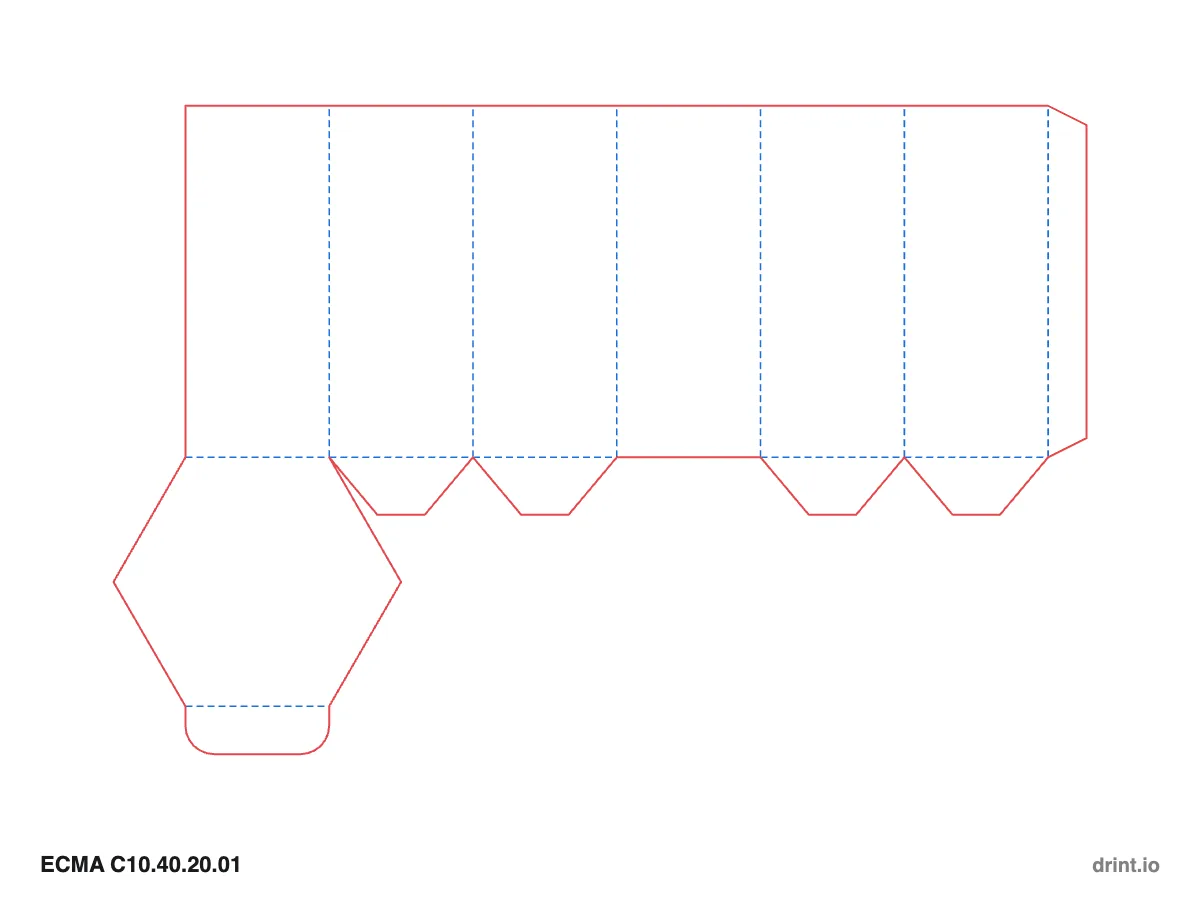
ECMA C10.40.20.01 is a glued hexagonal carton closed at the bottom by a tuck lid and left open at the top. Drint draws a free ECMA C10.40.20.01 dieline at any size: type the length, width and height and design on it, or download it as PDF or SVG with Pro.
- Code
- ECMA C10.40.20.01
- Standard
- ECMA — folding carton
- Group
- ECMA C · Polygonal cartons, glued side seam
- Drawn at
- 45 × 60 × 110 mm
- Flat sheet
- 305 × 203 mm
- Also called
- Polygonal carton lục giác prism glued seam tuckOpen ECMA C10
- Drawing
- Close to the code’s drawing, not exact
In Claude or ChatGPT, add the Drint connector (drint.io/mcp) and ask: “ECMA C10.40.20.01 dieline, 300 × 200 × 100 mm, PDF”.
How it folds
C10.40.20.01 turns the hexagonal tuck carton the other way up: the bottom has the tuck lid with a 15 mm tongue and 18 mm half-angle dust flaps, and the top is open. Drint's sample with 45 mm sides is 90 × 77.9 × 110 mm and its blank 304.5 × 202.9 mm. The geometry is Drint's own version of the code's style, so check flap sizes against the box maker's drawing.
What it is used for
It is a hexagonal cup or pot holder: filled from the top and then covered with a separate lid, a film or the product itself, such as a plant pot, a candle that stands proud of the rim, or a gift basket. It also serves as the base half of a two-part hexagonal box.
Blank size by box size
The flat sheet a ECMA C10.40.20.01 needs at each box size, measured on Drint’s own dieline with the board’s thickness allowed for. Add your press’s trim and gripper margin. Each size opens the die in the studio.
| Box, L × W × H | Flat sheet | Sheet area |
|---|---|---|
| 25 × 30 × 55 mm | 175 × 113 mm | 0.02 m² |
| 30 × 40 × 75 mm | 207 × 142 mm | 0.03 m² |
| 45 × 60 × 110 mm | 305 × 203 mm | 0.06 m² |
| 60 × 80 × 145 mm | 402 × 264 mm | 0.11 m² |
| 70 × 95 × 175 mm | 467 × 311 mm | 0.15 m² |
| 90 × 120 × 220 mm | 597 × 391 mm | 0.23 m² |
Measured by Drint’s die engine
These numbers are measured on the ECMA C10.40.20.01 die at 45 × 60 × 110 mm, drawn by the same engine as the studio — not copied from a catalogue.
| Cutting rule | 1.04 m |
|---|---|
| Creasing rule | 0.93 m |
| Total rule per copy | 1.97 m |
| Blank area (board in the box) | 0.039 m² |
| Share of the bounding box used | 63.1% |
| Board per 1,000 blanks (bounding box) | 62 m² |
| Best press sheet | 72 × 102 cm, cut in 3: 4 up nested (grid: 3), 63.7% of the sheet used |
Parts of this die: Glue flap · Dust flap · Tuck flap · Closure panel · Front panel · Back panel
Board
Folding boxboard 300–400 gsm, as the tuck bottom carries the load; for anything over a few hundred grams, a rosette bottom (C10.40.90.01) holds better than a tuck. Micro-flute E is an option for heavier pots.
Printing and die notes
The open top shows the inside, so use board with a clean white or printed inner face if it is displayed. Keep the bottom tuck plain unless the base is visible on shelf.
Common mistakes
- Loading a heavy item on a tuck bottom, which can push open.
- Leaving the inside grey board when the open top shows it to customers.
- Forgetting a lid when the contents need to be closed in transit.
Questions
What is ECMA C10.40.20.01?
ECMA C10.40.20.01 is a glued hexagonal carton closed at the bottom by a tuck lid and left open at the top.
How does C10.40.20.01 differ from C10.40.01.20?
They are mirror images: here the tuck closes the bottom and the top is open; in .01.20 the top tucks and the bottom is open.
What if the product is heavy?
Use the rosette bottom version, C10.40.90.01, or a heavier board.
What size sheet does a 45 × 60 × 110 mm ECMA C10.40.20.01 need?
A ECMA C10.40.20.01 of 45 × 60 × 110 mm unfolds to a flat sheet of 305 × 203 mm (0.06 m²) on Drint’s dieline, before trim and gripper margins. The table on this page gives the sheet for other sizes; in the studio, type any length, width and height and the sheet is measured again.
How do I get a ECMA C10.40.20.01 dieline at my size?
Open it in Drint and type your length, width and height — inside, on the crease or outside. The die is redrawn at that size with the board’s thickness allowed for, and you design straight on it. In Claude or ChatGPT with the Drint connector, ask for “ECMA C10.40.20.01 dieline” and your size.
What board is ECMA C10.40.20.01 made from?
Folding boxboard 300–400 gsm, as the tuck bottom carries the load; for anything over a few hundred grams, a rosette bottom (C10.40.90.01) holds better than a tuck. Micro-flute E is an option for heavier pots.
Is the ECMA C10.40.20.01 dieline free?
Designing on the die, the 3D fold and preflight are free in the browser. Downloading the dieline (SVG, PDF / AI, or DXF and CF2 for the die-maker) and the CMYK print PDF needs Pro.
Is Drint’s ECMA C10.40.20.01 exactly the FEFCO drawing?
Not exactly: Drint draws this code close to the FEFCO drawing. Check the die with your die-maker before production.