Dielines › Dielines by standard code › ECMA A20.41.01.03
ECMA A20.41.01.03 — Winged tuck with dust flaps top · tuck bottom · opposite sides
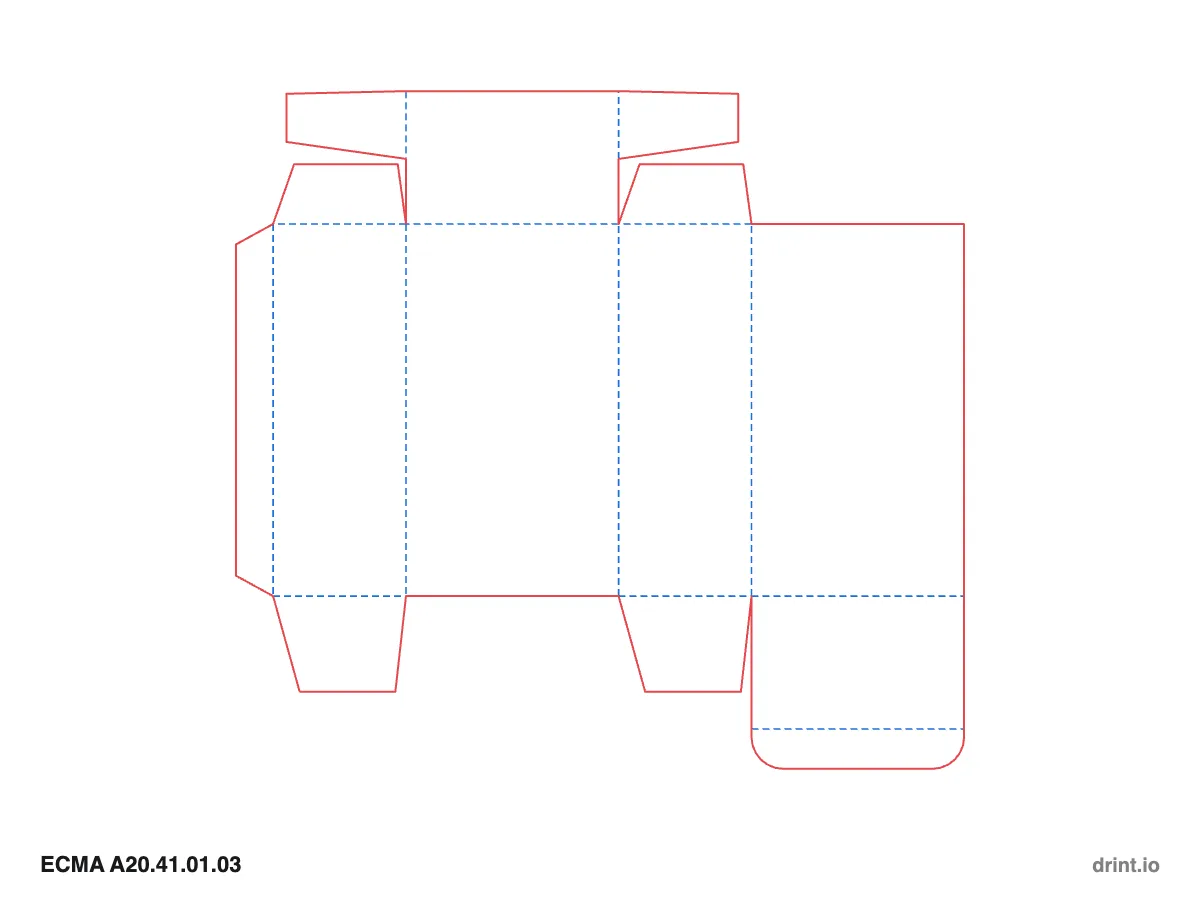
ECMA A20.41.01.03 is a folding carton (ECMA A-series) whose top is a tuck with winged side flaps over dust flaps and whose bottom is a tuck-in flap, hinged on opposite panels. A tuck bottom suits light products — cosmetics, cards, small electronics — and is folded by hand. Drint draws a free ECMA A20.41.01.03 dieline at any size: type the length, width and height and design on it, or download it as PDF or SVG with Pro.
- Code
- ECMA A20.41.01.03
- Standard
- ECMA — folding carton
- Group
- ECMA A20 · Tuck bottom
- Drawn at
- 80 × 50 × 140 mm
- Flat sheet
- 274 × 255 mm
- Drawing
- Follows the code’s drawing
In Claude or ChatGPT, add the Drint connector (drint.io/mcp) and ask: “ECMA A20.41.01.03 dieline, 300 × 200 × 100 mm, PDF”.
How it folds
A20.41.01.03 has a winged tuck top hinged on the front panel (the hinge runs along L, the flap is W deep), with dust flaps about half the lid's depth on the two side panels and lid wings that start past them, and a tuck bottom hinged on the back panel (the hinge runs along L, the flap is W deep), tucking into the front panel with dust flaps on the two side panels. The ends hinge on opposite panels (the back panel at the bottom, the front panel at the top), as in a reverse tuck end, so the end flaps point opposite ways, blanks nest on the sheet and the carton runs well on cartoners.
What it is used for
Dust flaps plus wings close tighter than a plain tuck, keeping dust out and holding loose contents such as tea, sachets, small parts or a stack of cards. With the top on the front panel it opens front-to-back across the length, the usual arrangement for cartons faced front-on in a shelf row. The tuck bottom is folded by hand and keeps contents to a few hundred grams.
Blank size by box size
The flat sheet a ECMA A20.41.01.03 needs at each box size, measured on Drint’s own dieline with the board’s thickness allowed for. Add your press’s trim and gripper margin. Each size opens the die in the studio.
| Box, L × W × H | Flat sheet | Sheet area |
|---|---|---|
| 40 × 25 × 70 mm | 144 × 135 mm | 0.02 m² |
| 55 × 35 × 100 mm | 194 × 185 mm | 0.04 m² |
| 80 × 50 × 140 mm | 274 × 255 mm | 0.07 m² |
| 105 × 65 × 180 mm | 354 × 325 mm | 0.12 m² |
| 130 × 80 × 225 mm | 434 × 400 mm | 0.17 m² |
| 160 × 100 × 280 mm | 534 × 495 mm | 0.26 m² |
Measured by Drint’s die engine
These numbers are measured on the ECMA A20.41.01.03 die at 80 × 50 × 140 mm, drawn by the same engine as the studio — not copied from a catalogue.
| Cutting rule | 1.39 m |
|---|---|
| Creasing rule | 1.05 m |
| Total rule per copy | 2.44 m |
| Blank area (board in the box) | 0.054 m² |
| Share of the bounding box used | 77.9% |
| Board per 1,000 blanks (bounding box) | 70 m² |
| Best press sheet | 60 × 84 cm: 6 up, 64.8% of the sheet used |
Parts of this die: Glue flap · Dust flap · Tuck flap · Closure panel · Lid wing · Front panel · Side panel · Back panel
Board
Folding boxboard 280–350 gsm works; the dust flaps add board but let the wings stay short. With both ends on opposite wide panels the blanks nest closely, so board use is about as low as this style gets.
Printing and die notes
Dust flaps and wings are hidden when closed, so print only the lid; keep the creases crisp and coatings light where the wings fold. One flap opens on each wide face, so text on the two end flaps is set in opposite directions. Seen from the front, the top edge of the front is the lid hinge, a clean fold, and the bottom tongue tucks into the front from below, so the front lower edge is a cut edge rather than a fold.
Common mistakes
- Starting the wings before the dust flaps end, so the two collide on closing.
- Laying out the artwork as a straight tuck end, so text on one end flap reads upside down.
- Using the tuck bottom for heavy or glass contents, so it opens under the weight.
Questions
What is ECMA A20.41.01.03?
ECMA A20.41.01.03 is a folding carton (ECMA A-series) whose top is a tuck with winged side flaps over dust flaps and whose bottom is a tuck-in flap, hinged on opposite panels. A tuck bottom suits light products — cosmetics, cards, small electronics — and is folded by hand.
What do the dust flaps add on A20.41.01.03?
They close the corners under the lid while the wings, starting past them, lock it, so the top closes tighter than a plain winged tuck.
Why do the ends of A20.41.01.03 hinge on opposite panels?
Like a reverse tuck end, the flaps point opposite ways, so blanks nest on the sheet and the carton runs well on cartoning machines.
What size sheet does a 80 × 50 × 140 mm ECMA A20.41.01.03 need?
A ECMA A20.41.01.03 of 80 × 50 × 140 mm unfolds to a flat sheet of 274 × 255 mm (0.07 m²) on Drint’s dieline, before trim and gripper margins. The table on this page gives the sheet for other sizes; in the studio, type any length, width and height and the sheet is measured again.
How do I get a ECMA A20.41.01.03 dieline at my size?
Open it in Drint and type your length, width and height — inside, on the crease or outside. The die is redrawn at that size with the board’s thickness allowed for, and you design straight on it. In Claude or ChatGPT with the Drint connector, ask for “ECMA A20.41.01.03 dieline” and your size.
What board is ECMA A20.41.01.03 made from?
Folding boxboard 280–350 gsm works; the dust flaps add board but let the wings stay short. With both ends on opposite wide panels the blanks nest closely, so board use is about as low as this style gets.
Is the ECMA A20.41.01.03 dieline free?
Designing on the die, the 3D fold and preflight are free in the browser. Downloading the dieline (SVG, PDF / AI, or DXF and CF2 for the die-maker) and the CMYK print PDF needs Pro.