Dielines › Dielines by standard code › ECMA A20.15.01.01
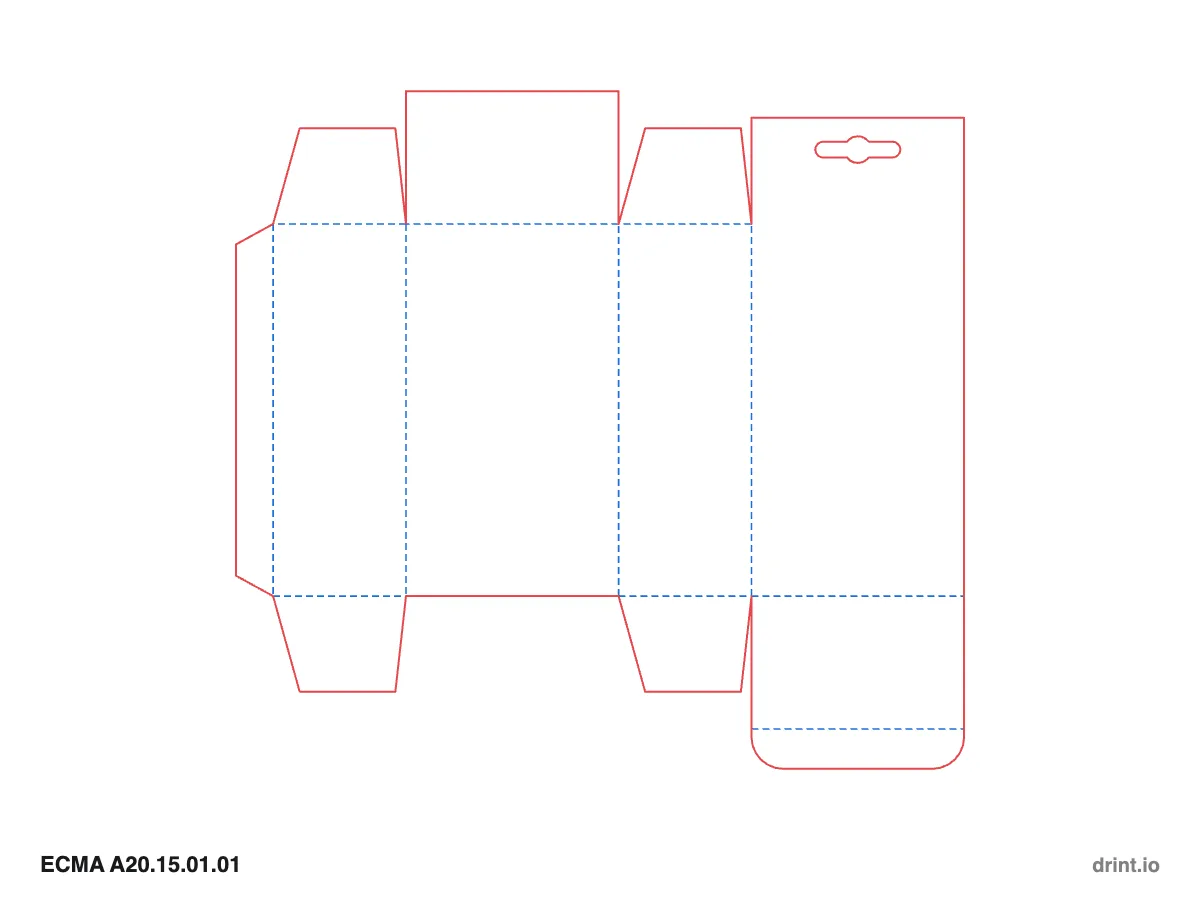
ECMA A20.15.01.01 — Glued with extended back (hang tab) top · tuck bottom · same side
ECMA A20.15.01.01 is a folding carton (ECMA A-series) whose top is a lid glued down on the dust flaps, the panel the code names running on above it as a hang tab (the lid hinges on the opposite panel) and whose bottom is a tuck-in flap, both hinged on the same panel. A tuck bottom suits light products — cosmetics, cards, small electronics — and is folded by hand. The hang tab lets it hang on a retail peg hook. Drint draws a free ECMA A20.15.01.01 dieline at any size: type the length, width and height and design on it, or download it as PDF or SVG with Pro.
- Code
- ECMA A20.15.01.01
- Standard
- ECMA — folding carton
- Group
- ECMA A20 · Tuck bottom
- Drawn at
- 80 × 50 × 140 mm
- Flat sheet
- 274 × 255 mm
- Drawing
- Follows the code’s drawing
In Claude or ChatGPT, add the Drint connector (drint.io/mcp) and ask: “ECMA A20.15.01.01 dieline, 300 × 200 × 100 mm, PDF”.
How it folds
A20.15.01.01 has a glued lid hinged on the front panel and stuck down on the dust flaps, while the back panel runs on above the top into a hang tab with a euro slot, and a tuck bottom hinged on the back panel (the hinge runs along L, the flap is W deep), tucking into the front panel with dust flaps on the two side panels. The bottom tuck hinges on the back panel, the hang-tab panel, so that panel runs unbroken from the bottom crease to the euro slot while the front panel carries both the lid hinge and the bottom tongue.
What it is used for
The hang tab puts it on a retail peg hook while the glued lid keeps it sealed, typical for batteries, cables, small tools, hardware and accessories sold on pegboards. With the back running up into the tab, the front face stays the full height of the carton and the tab sits behind it, so the reverse of the tab shows above the top. The tuck bottom is folded by hand and keeps contents to a few hundred grams.
Blank size by box size
The flat sheet a ECMA A20.15.01.01 needs at each box size, measured on Drint’s own dieline with the board’s thickness allowed for. Add your press’s trim and gripper margin. Each size opens the die in the studio.
| Box, L × W × H | Flat sheet | Sheet area |
|---|---|---|
| 40 × 25 × 70 mm | 144 × 135 mm | 0.02 m² |
| 55 × 35 × 100 mm | 194 × 185 mm | 0.04 m² |
| 80 × 50 × 140 mm | 274 × 255 mm | 0.07 m² |
| 105 × 65 × 180 mm | 354 × 325 mm | 0.12 m² |
| 130 × 80 × 225 mm | 434 × 400 mm | 0.17 m² |
| 160 × 100 × 280 mm | 534 × 495 mm | 0.26 m² |
Measured by Drint’s die engine
These numbers are measured on the ECMA A20.15.01.01 die at 80 × 50 × 140 mm, drawn by the same engine as the studio — not copied from a catalogue.
| Cutting rule | 1.43 m |
|---|---|
| Creasing rule | 1.00 m |
| Total rule per copy | 2.43 m |
| Blank area (board in the box) | 0.057 m² |
| Share of the bounding box used | 81.3% |
| Board per 1,000 blanks (bounding box) | 70 m² |
| Best press sheet | 60 × 84 cm: 6 up, 67.6% of the sheet used |
Parts of this die: Glue flap · Dust flap · Tuck flap · Closure panel · Front panel · Side panel · Back panel · Cut-out
Board
Use a solid 300–400 gsm boxboard so the hang tab does not tear at the slot or droop forward on the hook, and leave the lid and dust-flap glue areas uncoated. The extended panel adds the tab height to the blank, so allow for it in the sheet layout.
Printing and die notes
Keep the euro slot and a margin round it clear of text and barcodes, and leave the glue areas on the lid and dust flaps free of varnish and lamination. Because the back is extended, shoppers see the inner face of the tab above the carton: print the reverse there or use a board with a clean white back. Seen from the front, the top edge of the front is the lid hinge, a clean fold, and the bottom tongue tucks into the front from below, so the front lower edge is a cut edge rather than a fold.
Common mistakes
- Using board too thin for the hang tab, so the carton tilts forward on the hook.
- Leaving the inner face of the extended back unprinted grey, so it looks unfinished above the carton.
- Using the tuck bottom for heavy or glass contents, so it opens under the weight.
Questions
What is ECMA A20.15.01.01?
ECMA A20.15.01.01 is a folding carton (ECMA A-series) whose top is a lid glued down on the dust flaps, the panel the code names running on above it as a hang tab (the lid hinges on the opposite panel) and whose bottom is a tuck-in flap, both hinged on the same panel. A tuck bottom suits light products — cosmetics, cards, small electronics — and is folded by hand. The hang tab lets it hang on a retail peg hook.
Can A20.15.01.01 be reopened?
Not cleanly: the lid is glued down on the dust flaps, so the carton is sealed until torn open; choose the 21 style if it must reclose on the hook.
Which face of A20.15.01.01 runs up into the hang tab?
The back panel; the lid hinges on the front panel and the bottom tuck on the back panel.
What size sheet does a 80 × 50 × 140 mm ECMA A20.15.01.01 need?
A ECMA A20.15.01.01 of 80 × 50 × 140 mm unfolds to a flat sheet of 274 × 255 mm (0.07 m²) on Drint’s dieline, before trim and gripper margins. The table on this page gives the sheet for other sizes; in the studio, type any length, width and height and the sheet is measured again.
How do I get a ECMA A20.15.01.01 dieline at my size?
Open it in Drint and type your length, width and height — inside, on the crease or outside. The die is redrawn at that size with the board’s thickness allowed for, and you design straight on it. In Claude or ChatGPT with the Drint connector, ask for “ECMA A20.15.01.01 dieline” and your size.
What board is ECMA A20.15.01.01 made from?
Use a solid 300–400 gsm boxboard so the hang tab does not tear at the slot or droop forward on the hook, and leave the lid and dust-flap glue areas uncoated. The extended panel adds the tab height to the blank, so allow for it in the sheet layout.
Is the ECMA A20.15.01.01 dieline free?
Designing on the die, the 3D fold and preflight are free in the browser. Downloading the dieline (SVG, PDF / AI, or DXF and CF2 for the die-maker) and the CMYK print PDF needs Pro.