Drint Knowledge › Packaging glossary › Electrical rating label
Electrical rating label
The voltage, frequency and power or current an electrical product is designed for, printed on the product or pack.
- Also called
- rated voltage and power, rating plate
- Kind
- Labels, barcodes & law
- Label laws that ask for it
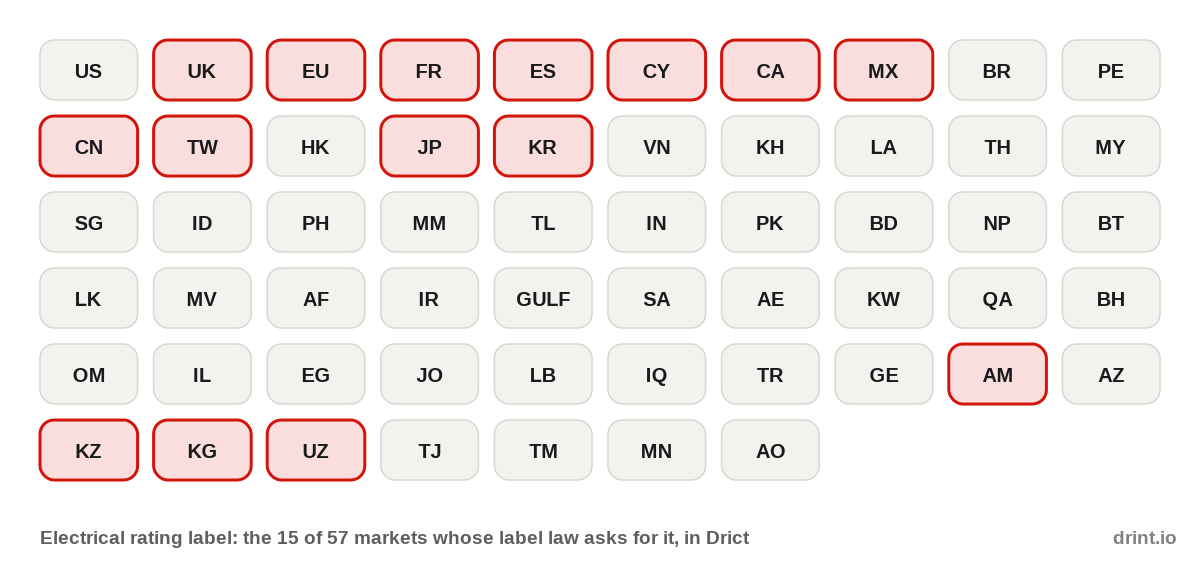
- 15 of the 57 markets Drint checks
- Mandatory in
- 9
- Example
- Rated voltage, frequency and power — designated standards (BS EN 60335-1, BS EN 62368-1)
- Measured
A rating label tells users what supply the device needs and how much it draws, for example 220–240 V, 50 Hz, 1000 W. It prevents connecting the product to the wrong supply and helps installers size cables and fuses.
It is usually printed or etched on a plate on the product itself and repeated on the pack, with units written as standard symbols. Make sure the values on pack and product match exactly.
Where the law asks for it
Questions
What is a electrical rating label?
The voltage, frequency and power or current an electrical product is designed for, printed on the product or pack.
More terms
Cite this page: Drint (2026). “Electrical rating label”. Drint Knowledge. https://drint.io/glossary/electrical-rating-label