Drint Knowledge › Packaging glossary › Age grading
Age grading
In short
A mark or statement on a toy or children’s product giving the age range it is made and tested for.
- Also called
- recommended age, age pictogram
- Kind
- Labels, barcodes & law
- Label laws that ask for it
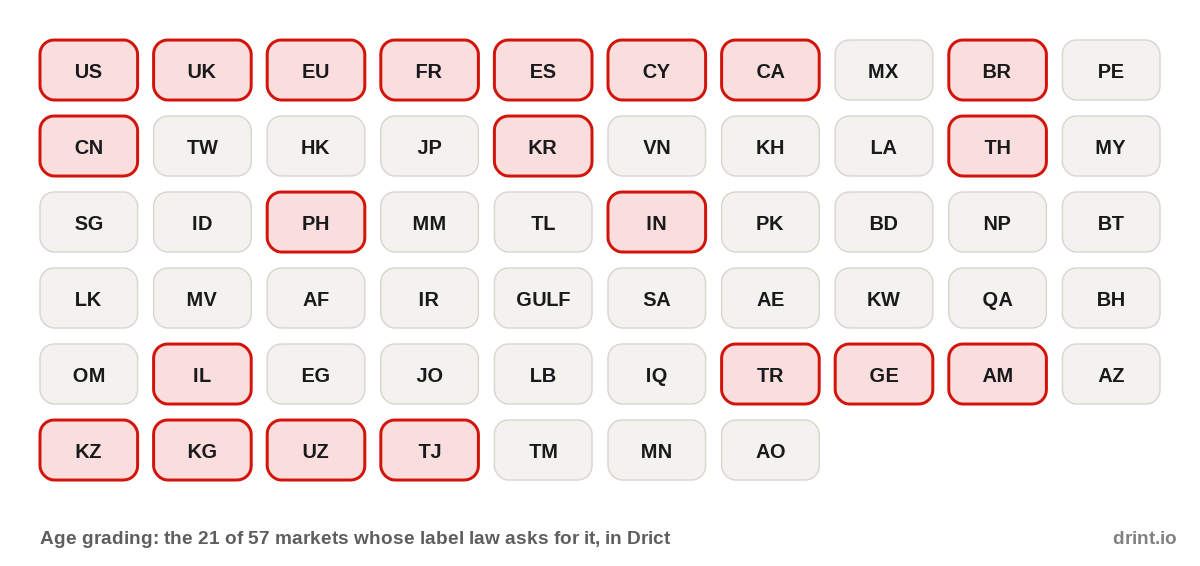
- 21 of the 57 markets Drint checks
- Mandatory in
- 15
- Example
- Age grading on the package — ASTM F963 (16 CFR Part 1250)
- Measured
Age grading tells buyers which children a product suits, based on safety tests and how children play at each stage. It appears as a number range or as a pictogram, and the choice of age sets which safety tests apply.
Show it on the front or side where parents look first and do not set it lower than the testing allows to reach more buyers. The age must match the one used in the safety documents.
Where the law asks for it
United StatesUnited KingdomEuropean Union (other member states)FranceSpainCyprusCanadaBrazilChinaSouth KoreaThailandPhilippinesIndiaIsraelTürkiyeGeorgiaArmeniaKazakhstanKyrgyzstanUzbekistanTajikistan
Questions
What is a age grading?
A mark or statement on a toy or children’s product giving the age range it is made and tested for.
More terms
Product name on the labelNet quantityMetric units on labelsIngredient listQuantitative ingredient declarationAllergen declarationFragrance and allergenic perfume declarationNutrition declarationServing sizeReference intake percentage
Cite this page: Drint (2026). “Age grading”. Drint Knowledge. https://drint.io/glossary/age-grading