Dielines › Dielines by standard code › ECMA C30.10.10.01
ECMA C30.10.10.01 — Triangular pyramid (tetrahedron) box
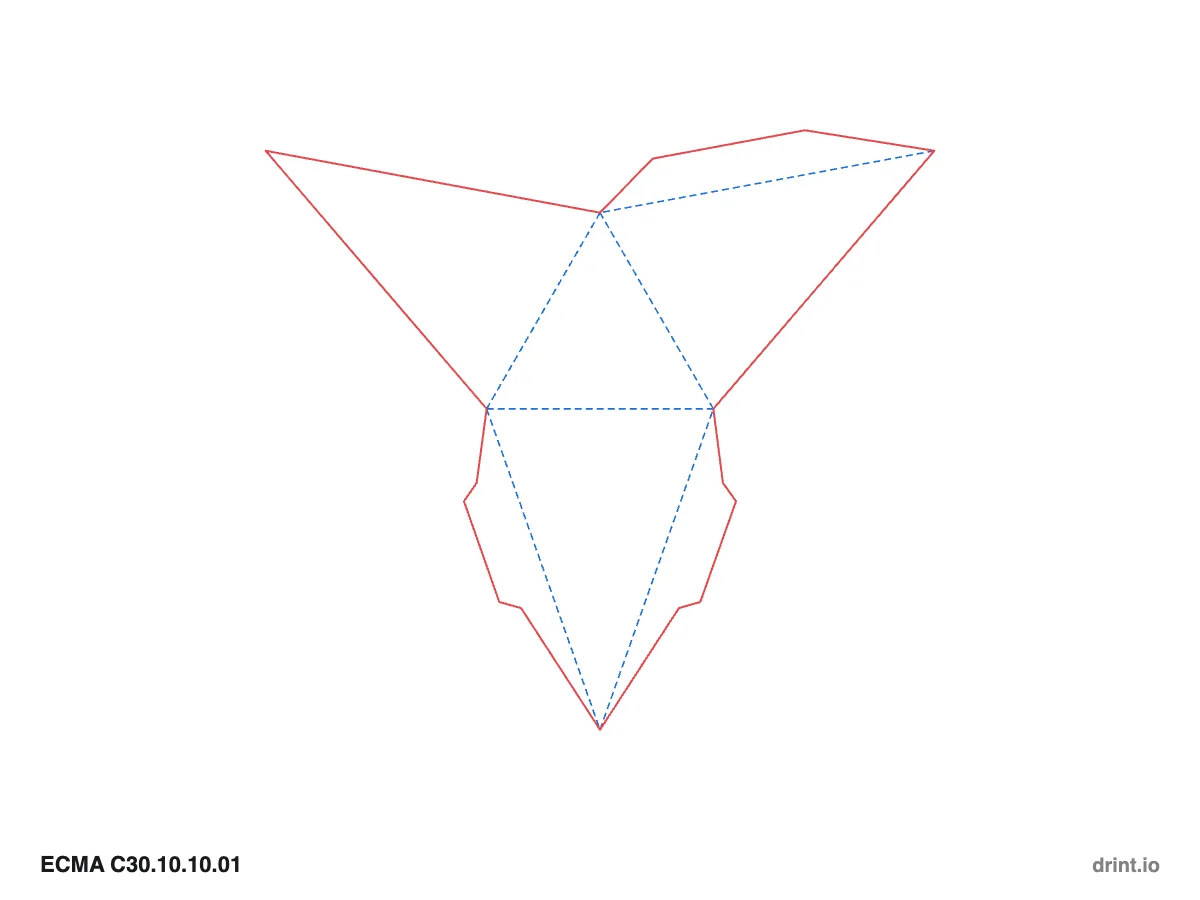
ECMA C30.10.10.01 is a four-faced pyramid carton on a triangular base, closed by a tuck-in face. Drint draws a free ECMA C30.10.10.01 dieline at any size: type the length, width and height and design on it, or download it as PDF or SVG with Pro.
- Code
- ECMA C30.10.10.01
- Standard
- ECMA — folding carton
- Group
- ECMA C · Polygonal cartons, glued side seam
- Drawn at
- 60 × 0 × 0 mm
- Flat sheet
- 153 × 137 mm
- Also called
- Triangular pyramid tetrahedron cone box
- Drawing
- Close to the code’s drawing, not exact
In Claude or ChatGPT, add the Drint connector (drint.io/mcp) and ask: “ECMA C30.10.10.01 dieline, 300 × 200 × 100 mm, PDF”.
How it folds
C30.10.10.01 is the simplest pyramid: three triangular sides and a triangular base, four faces in all, joined by one 10 mm glue flap, with the face marked as the opening tucked in by a 12 mm tongue. Drint's sample (60 mm base side) folds to 52 × 45 × 72 mm from a 153.4 × 137.5 mm blank. The geometry is Drint's own in the code's style, so check flap sizes against the box maker's drawing.
What it is used for
Small novelty packs: single chocolates, sweets, tea bags, seeds, samples, party favours and give-aways. Its compact blank makes it economical for large promotional runs.
Blank size by box size
The flat sheet a ECMA C30.10.10.01 needs at each box size, measured on Drint’s own dieline with the board’s thickness allowed for. Add your press’s trim and gripper margin. Each size opens the die in the studio.
| Box, L × W × H | Flat sheet | Sheet area |
|---|---|---|
| 30 × 10 × 10 mm | 35 × 34 mm | 0.00 m² |
| 40 × 10 × 10 mm | 45 × 41 mm | 0.00 m² |
| 60 × 0 × 0 mm | 153 × 137 mm | 0.02 m² |
| 80 × 10 × 10 mm | 85 × 73 mm | 0.01 m² |
| 95 × 10 × 10 mm | 100 × 86 mm | 0.01 m² |
| 120 × 10 × 10 mm | 125 × 107 mm | 0.01 m² |
Measured by Drint’s die engine
These numbers are measured on the ECMA C30.10.10.01 die at 60 × 0 × 0 mm, drawn by the same engine as the studio — not copied from a catalogue.
| Cutting rule | 0.49 m |
|---|---|
| Creasing rule | 0.39 m |
| Total rule per copy | 0.88 m |
| Blank area (board in the box) | 0.009 m² |
| Share of the bounding box used | 40.5% |
| Board per 1,000 blanks (bounding box) | 21 m² |
| Best press sheet | 60 × 84 cm: 36 up nested (grid: 20), 61.0% of the sheet used |
Parts of this die: Glue flap · Tuck flap · Front panel · Base panel
Board
Folding boxboard 250–350 gsm; the faces are small and stiff on their own, so lighter board works. Stiffer board keeps the tuck tight.
Printing and die notes
All four faces are equilateral-style triangles, so a pattern that tiles across faces works well. Plan which face sits on the table and which one opens, and keep text away from the three corners where creases converge.
Common mistakes
- Designing every face upright without deciding which is the base.
- Putting text into the corners where creases meet.
- Making the tuck tongue too short for the board.
Questions
What is ECMA C30.10.10.01?
ECMA C30.10.10.01 is a four-faced pyramid carton on a triangular base, closed by a tuck-in face.
Why does a triangular pyramid have only one glue flap?
With four faces the blank folds round on itself, and one flap joins the last edge; the opening face closes with a tuck.
How are the sizes given?
Drint takes the base side (60 mm) and reports the folded extent, here 52 × 45 × 72 mm.
What size sheet does a 60 × 0 × 0 mm ECMA C30.10.10.01 need?
A ECMA C30.10.10.01 of 60 × 0 × 0 mm unfolds to a flat sheet of 153 × 137 mm (0.02 m²) on Drint’s dieline, before trim and gripper margins. The table on this page gives the sheet for other sizes; in the studio, type any length, width and height and the sheet is measured again.
How do I get a ECMA C30.10.10.01 dieline at my size?
Open it in Drint and type your length, width and height — inside, on the crease or outside. The die is redrawn at that size with the board’s thickness allowed for, and you design straight on it. In Claude or ChatGPT with the Drint connector, ask for “ECMA C30.10.10.01 dieline” and your size.
What board is ECMA C30.10.10.01 made from?
Folding boxboard 250–350 gsm; the faces are small and stiff on their own, so lighter board works. Stiffer board keeps the tuck tight.
Is the ECMA C30.10.10.01 dieline free?
Designing on the die, the 3D fold and preflight are free in the browser. Downloading the dieline (SVG, PDF / AI, or DXF and CF2 for the die-maker) and the CMYK print PDF needs Pro.
Is Drint’s ECMA C30.10.10.01 exactly the FEFCO drawing?
Not exactly: Drint draws this code close to the FEFCO drawing. Check the die with your die-maker before production.