Dielines › Dielines by standard code › ECMA A41.15.02.01
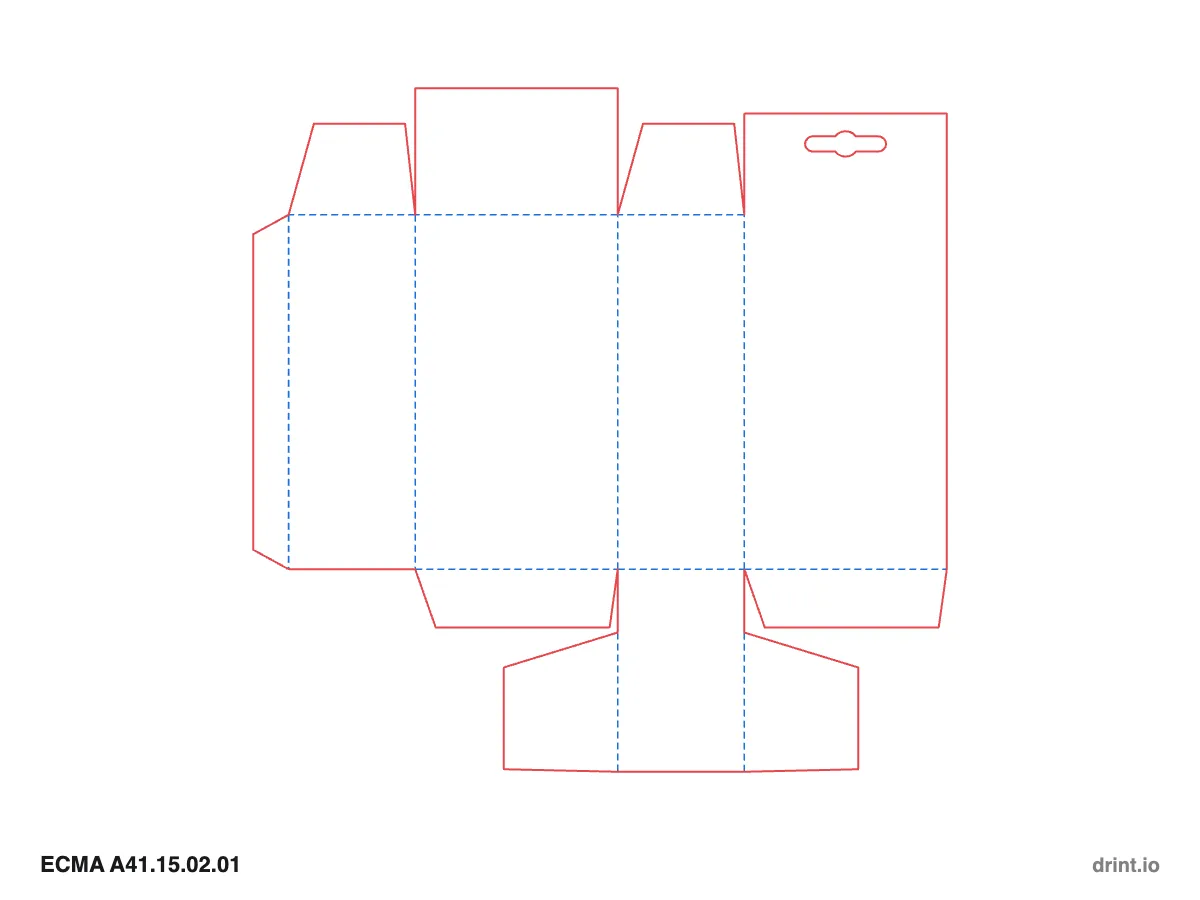
ECMA A41.15.02.01 — Glued with extended back (hang tab) top · winged tuck with dust flaps bottom · top on back, bottom on right side panel
ECMA A41.15.02.01 is a folding carton (ECMA A-series) whose top is a lid glued down on the dust flaps, the panel the code names running on above it as a hang tab (the lid hinges on the opposite panel) and whose bottom is a tuck with winged side flaps over dust flaps, the top hinged on the back panel and the bottom on the right side panel. Winged flaps over dust flaps close the end more tightly than plain wings, keeping dust and small parts in. The hang tab lets it hang on a retail peg hook. Drint draws a free ECMA A41.15.02.01 dieline at any size: type the length, width and height and design on it, or download it as PDF or SVG with Pro.
- Code
- ECMA A41.15.02.01
- Standard
- ECMA — folding carton
- Group
- ECMA A40 · Winged tuck bottom
- Drawn at
- 80 × 50 × 140 mm
- Flat sheet
- 274 × 270 mm
- Drawing
- Follows the code’s drawing
In Claude or ChatGPT, add the Drint connector (drint.io/mcp) and ask: “ECMA A41.15.02.01 dieline, 300 × 200 × 100 mm, PDF”.
How it folds
A41.15.02.01 has a winged tuck bottom with dust flaps on the right side panel: the flap is L deep, hinged along the width W, dust flaps about half its depth fold in from the front and back panels, and the wings start past them. On top it has a glued lid on the front panel, stuck down on the dust flaps, while the back panel runs on above the top as a hang tab with a euro slot. The bottom hinges along the width on the right side, so its flap is L deep and opens side-to-side, while the lid on the front is W deep; the hang tab rises from the back and the blank is irregular, nesting less well.
What it is used for
The hang tab puts it on a retail peg hook while the glued lid keeps the top shut; the product goes in through the reclosable winged bottom, which suits chargers, small tools and accessories. The dust flaps under the winged bottom close its corners, so powder sachets, screws, beads or other small loose parts stay in. Mixing a wide and a narrow hinge suits a product loaded from the side at one end and opened from the face at the other, for example a tube or pen pack with a display end.
Blank size by box size
The flat sheet a ECMA A41.15.02.01 needs at each box size, measured on Drint’s own dieline with the board’s thickness allowed for. Add your press’s trim and gripper margin. Each size opens the die in the studio.
| Box, L × W × H | Flat sheet | Sheet area |
|---|---|---|
| 40 × 25 × 70 mm | 144 × 135 mm | 0.02 m² |
| 55 × 35 × 100 mm | 194 × 190 mm | 0.04 m² |
| 80 × 50 × 140 mm | 274 × 270 mm | 0.07 m² |
| 105 × 65 × 180 mm | 354 × 350 mm | 0.12 m² |
| 130 × 80 × 225 mm | 434 × 435 mm | 0.19 m² |
| 160 × 100 × 280 mm | 534 × 540 mm | 0.29 m² |
Measured by Drint’s die engine
These numbers are measured on the ECMA A41.15.02.01 die at 80 × 50 × 140 mm, drawn by the same engine as the studio — not copied from a catalogue.
| Cutting rule | 1.58 m |
|---|---|
| Creasing rule | 1.06 m |
| Total rule per copy | 2.64 m |
| Blank area (board in the box) | 0.060 m² |
| Share of the bounding box used | 81.4% |
| Board per 1,000 blanks (bounding box) | 74 m² |
| Best press sheet | 60 × 84 cm: 6 up, 71.7% of the sheet used |
Parts of this die: Glue flap · Dust flap · Closure panel · Lid wing · Front panel · Side panel · Back panel · Cut-out
Board
Use solid folding boxboard or SBS 300–400 gsm: the hang tab carries the whole carton on the peg, and the glued lid needs uncoated glue areas. The bottom flap on the narrow panel is L deep rather than W, so that end of the blank grows; check it still fits the sheet. The bottom dust flaps add a small strip of board on each side.
Printing and die notes
Keep the euro slot and a margin around it clear of print and foil, keep glue areas uncoated, and remember the hang tab shows on both faces. The two end flaps sit at 90° to each other, so set the copy direction on each flap separately. The bottom wings need crisp, uncracked creases, so avoid heavy coating on them.
Common mistakes
- Starting the bottom wings too close to the hinge, so they clash with the dust flaps instead of sliding past them.
- Printing or foiling across the euro slot, or using thin board, so the hang tab tears on the peg.
- Drawing both end flaps the same depth, when the one on the right side panel must be L deep.
Questions
What is ECMA A41.15.02.01?
ECMA A41.15.02.01 is a folding carton (ECMA A-series) whose top is a lid glued down on the dust flaps, the panel the code names running on above it as a hang tab (the lid hinges on the opposite panel) and whose bottom is a tuck with winged side flaps over dust flaps, the top hinged on the back panel and the bottom on the right side panel. Winged flaps over dust flaps close the end more tightly than plain wings, keeping dust and small parts in. The hang tab lets it hang on a retail peg hook.
What do the last two numbers in A41.15.02.01 mean?
02 puts the bottom on the right side panel and 01 makes the back panel the one that runs on into the hang tab, so the glued lid hinges on the front.
How does A41.15.02.01 differ from A40.15.02.01?
Only the bottom changes: A40.15.02.01 drops the bottom dust flaps and keeps the wings alone, slightly lighter but open at the corners.
What size sheet does a 80 × 50 × 140 mm ECMA A41.15.02.01 need?
A ECMA A41.15.02.01 of 80 × 50 × 140 mm unfolds to a flat sheet of 274 × 270 mm (0.07 m²) on Drint’s dieline, before trim and gripper margins. The table on this page gives the sheet for other sizes; in the studio, type any length, width and height and the sheet is measured again.
How do I get a ECMA A41.15.02.01 dieline at my size?
Open it in Drint and type your length, width and height — inside, on the crease or outside. The die is redrawn at that size with the board’s thickness allowed for, and you design straight on it. In Claude or ChatGPT with the Drint connector, ask for “ECMA A41.15.02.01 dieline” and your size.
What board is ECMA A41.15.02.01 made from?
Use solid folding boxboard or SBS 300–400 gsm: the hang tab carries the whole carton on the peg, and the glued lid needs uncoated glue areas. The bottom flap on the narrow panel is L deep rather than W, so that end of the blank grows; check it still fits the sheet. The bottom dust flaps add a small strip of board on each side.
Is the ECMA A41.15.02.01 dieline free?
Designing on the die, the 3D fold and preflight are free in the browser. Downloading the dieline (SVG, PDF / AI, or DXF and CF2 for the die-maker) and the CMYK print PDF needs Pro.