Dielines › Dielines by standard code › ECMA A12.21.00.03
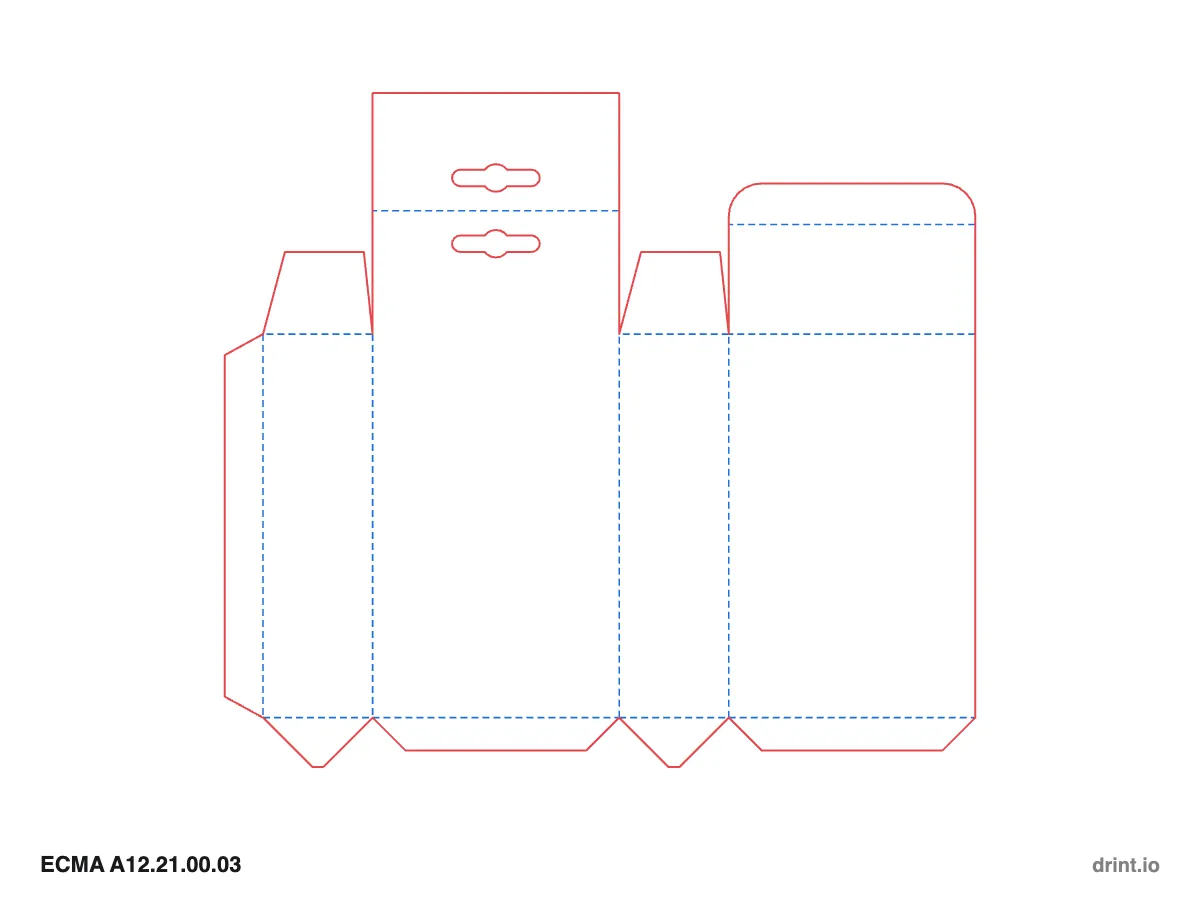
ECMA A12.21.00.03 — Tuck with hang tab top · four short-flap bottom · top on front panel
ECMA A12.21.00.03 is a folding carton (ECMA A-series) whose top is a tuck-in flap with a hang tab and whose bottom is four short flaps folded in, leaving an opening in the middle. The four short flaps leave the middle open: the product shows or stands through it, or the end is closed with tape or a label. The hang tab lets it hang on a retail peg hook. Drint draws a free ECMA A12.21.00.03 dieline at any size: type the length, width and height and design on it, or download it as PDF or SVG with Pro.
- Code
- ECMA A12.21.00.03
- Standard
- ECMA — folding carton
- Group
- ECMA A12 · Four short-flap bottom
- Drawn at
- 90 × 40 × 140 mm
- Flat sheet
- 274 × 246 mm
- Drawing
- Follows the code’s drawing
In Claude or ChatGPT, add the Drint connector (drint.io/mcp) and ask: “ECMA A12.21.00.03 dieline, 300 × 200 × 100 mm, PDF”.
How it folds
At the top of A12.21.00.03, the front panel runs on above the carton into a hang tab with a euro slot; the tuck lid hinges on the back panel and its tongue tucks down inside the tall front panel, with dust flaps on the side panels under the lid. The bottom is four short flaps, one on every panel, with the corners cut at 45° so they never meet, leaving an opening in the middle; it hangs on no single panel (00).
What it is used for
It hangs on a peg hook and recloses: phone accessories, batteries, brushes, small tools and cosmetic refills. The four-flap bottom forms a ledge that holds a product or insert larger than the opening, lets the base of the product show, or is closed with tape or a label after filling. Running the tab up from the front lets the front artwork carry straight onto the header.
Blank size by box size
The flat sheet a ECMA A12.21.00.03 needs at each box size, measured on Drint’s own dieline with the board’s thickness allowed for. Add your press’s trim and gripper margin. Each size opens the die in the studio.
| Box, L × W × H | Flat sheet | Sheet area |
|---|---|---|
| 45 × 20 × 70 mm | 144 × 127 mm | 0.02 m² |
| 65 × 30 × 100 mm | 204 × 178 mm | 0.04 m² |
| 90 × 40 × 140 mm | 274 × 246 mm | 0.07 m² |
| 115 × 50 × 180 mm | 344 × 291 mm | 0.10 m² |
| 145 × 65 × 225 mm | 434 × 342 mm | 0.15 m² |
| 180 × 80 × 280 mm | 534 × 411 mm | 0.22 m² |
Measured by Drint’s die engine
These numbers are measured on the ECMA A12.21.00.03 die at 90 × 40 × 140 mm, drawn by the same engine as the studio — not copied from a catalogue.
| Cutting rule | 1.39 m |
|---|---|
| Creasing rule | 1.17 m |
| Total rule per copy | 2.56 m |
| Blank area (board in the box) | 0.056 m² |
| Share of the bounding box used | 82.8% |
| Board per 1,000 blanks (bounding box) | 67 m² |
| Best press sheet | 60 × 84 cm: 6 up, 66.4% of the sheet used |
Parts of this die: Glue flap · Dust flap · Tuck flap · Closure panel · Hang tab · Front panel · Side panel · Back panel · Cut-out
Board
Folding boxboard 300–400 gsm keeps the hang tab from tearing at the euro slot; below about 300 gsm the tab tends to bend forward on the hook. The tuck or lock needs crisp, well-matched creases, so check the crease rule against the board caliper.
Printing and die notes
The framed opening shows the inside of the carton and whatever sits in it, so print the inner edges or use a board with a white back. Keep the euro slot and a margin round it free of print, and keep barcodes off the tab where the hook would hide them.
Common mistakes
- Sizing the opening too large, so the four short flaps give no ledge for the product or insert.
- Leaving the inside of a back-panel tab raw when that is the face shoppers see above the carton.
- Printing over the euro slot or putting the barcode on the hang tab, where the hook hides or tears it.
Questions
What is ECMA A12.21.00.03?
ECMA A12.21.00.03 is a folding carton (ECMA A-series) whose top is a tuck-in flap with a hang tab and whose bottom is four short flaps folded in, leaving an opening in the middle. The four short flaps leave the middle open: the product shows or stands through it, or the end is closed with tape or a label. The hang tab lets it hang on a retail peg hook.
What does the code A12.21.00.03 mean?
A12 is the bottom (four-short-flap bottom) and 21 the top (tuck top with hang tab); the bottom hangs on no single panel (00) and the top hangs on the front panel (03).
Why does the lid of A12.21.00.03 hinge on the back panel and not on the tab panel?
The front panel must run on unbroken into the hang tab, so the lid has to hinge on the opposite panel and its tongue tucks down inside the tall panel.
What size sheet does a 90 × 40 × 140 mm ECMA A12.21.00.03 need?
A ECMA A12.21.00.03 of 90 × 40 × 140 mm unfolds to a flat sheet of 274 × 246 mm (0.07 m²) on Drint’s dieline, before trim and gripper margins. The table on this page gives the sheet for other sizes; in the studio, type any length, width and height and the sheet is measured again.
How do I get a ECMA A12.21.00.03 dieline at my size?
Open it in Drint and type your length, width and height — inside, on the crease or outside. The die is redrawn at that size with the board’s thickness allowed for, and you design straight on it. In Claude or ChatGPT with the Drint connector, ask for “ECMA A12.21.00.03 dieline” and your size.
What board is ECMA A12.21.00.03 made from?
Folding boxboard 300–400 gsm keeps the hang tab from tearing at the euro slot; below about 300 gsm the tab tends to bend forward on the hook. The tuck or lock needs crisp, well-matched creases, so check the crease rule against the board caliper.
Is the ECMA A12.21.00.03 dieline free?
Designing on the die, the 3D fold and preflight are free in the browser. Downloading the dieline (SVG, PDF / AI, or DXF and CF2 for the die-maker) and the CMYK print PDF needs Pro.