Dielines › Dielines by standard code › ECMA A12.20.00.02
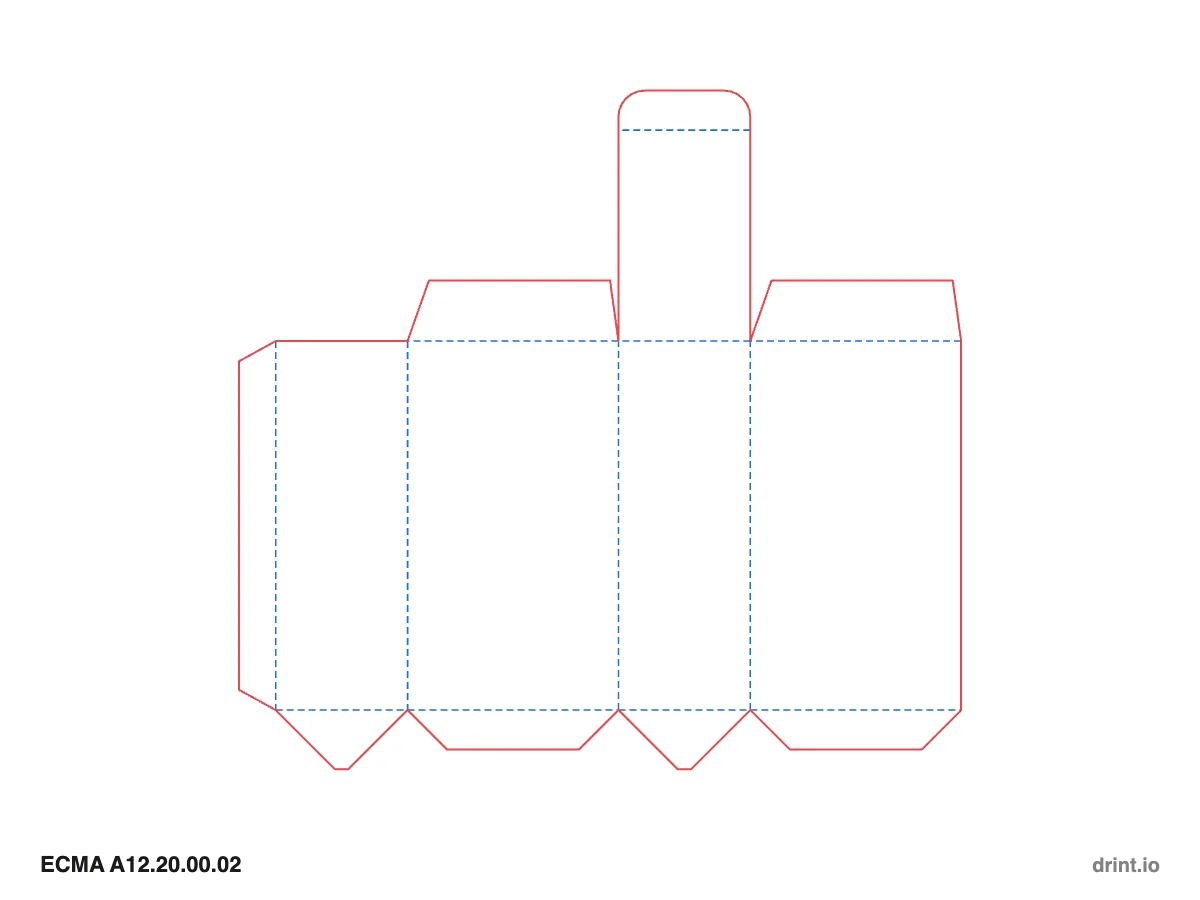
ECMA A12.20.00.02 — Tuck top · four short-flap bottom · top on right side panel
ECMA A12.20.00.02 is a folding carton (ECMA A-series) whose top is a tuck-in flap and whose bottom is four short flaps folded in, leaving an opening in the middle. The four short flaps leave the middle open: the product shows or stands through it, or the end is closed with tape or a label. Drint draws a free ECMA A12.20.00.02 dieline at any size: type the length, width and height and design on it, or download it as PDF or SVG with Pro.
- Code
- ECMA A12.20.00.02
- Standard
- ECMA — folding carton
- Group
- ECMA A12 · Four short-flap bottom
- Drawn at
- 80 × 50 × 140 mm
- Flat sheet
- 274 × 258 mm
- Drawing
- Follows the code’s drawing
In Claude or ChatGPT, add the Drint connector (drint.io/mcp) and ask: “ECMA A12.20.00.02 dieline, 300 × 200 × 100 mm, PDF”.
How it folds
In A12.20.00.02, the top is a tuck lid hinged on the right side panel, so it opens side-to-side: the lid is L deep, its tongue tucks into the left side panel and the dust flaps move to the front and back panels. The bottom is four short flaps, one on every panel, with the corners cut at 45° so they never meet, leaving an opening in the middle; it hangs on no single panel (00).
What it is used for
A reclosable tuck top over a glued base is a good fit for cosmetics, pharmaceuticals, tea, coffee and dry foods that are filled from the top and opened many times. The four-flap bottom forms a ledge that holds a product or insert larger than the opening, lets the base of the product show, or is closed with tape or a label after filling. Putting the lid on the right side panel leaves the front and back with clean top edges and lets a long, narrow product be lifted out from one end; it also suits cartons faced end-on on the shelf.
Blank size by box size
The flat sheet a ECMA A12.20.00.02 needs at each box size, measured on Drint’s own dieline with the board’s thickness allowed for. Add your press’s trim and gripper margin. Each size opens the die in the studio.
| Box, L × W × H | Flat sheet | Sheet area |
|---|---|---|
| 40 × 25 × 70 mm | 144 × 136 mm | 0.02 m² |
| 55 × 35 × 100 mm | 194 × 186 mm | 0.04 m² |
| 80 × 50 × 140 mm | 274 × 258 mm | 0.07 m² |
| 105 × 65 × 180 mm | 354 × 329 mm | 0.12 m² |
| 130 × 80 × 225 mm | 434 × 406 mm | 0.18 m² |
| 160 × 100 × 280 mm | 534 × 500 mm | 0.27 m² |
Measured by Drint’s die engine
These numbers are measured on the ECMA A12.20.00.02 die at 80 × 50 × 140 mm, drawn by the same engine as the studio — not copied from a catalogue.
| Cutting rule | 1.13 m |
|---|---|
| Creasing rule | 1.08 m |
| Total rule per copy | 2.21 m |
| Blank area (board in the box) | 0.050 m² |
| Share of the bounding box used | 70.3% |
| Board per 1,000 blanks (bounding box) | 71 m² |
| Best press sheet | 72 × 102 cm: 9 up nested (grid: 6), 60.7% of the sheet used |
Parts of this die: Glue flap · Dust flap · Tuck flap · Closure panel · Front panel · Side panel · Back panel
Board
Folding boxboard 300–400 gsm keeps the short flaps stiff enough to act as a ledge; if they carry the product's weight, consider E-flute. The tuck or lock needs crisp, well-matched creases, so check the crease rule against the board caliper. On a narrow panel the lid is L deep, so the blank grows in that direction and needs a longer sheet and more board.
Printing and die notes
The framed opening shows the inside of the carton and whatever sits in it, so print the inner edges or use a board with a white back. The lid opens from the right side panel, so lid text should read across the carton from the front, and the front's top edge is a plain dust-flap fold with no tongue slot.
Common mistakes
- Sizing the opening too large, so the four short flaps give no ledge for the product or insert.
- Putting no thumb cut under the tongue, so the lid is hard to lift.
- Placing lid text as if the lid opened from the front, when on the right side panel it swings sideways and reads rotated.
Questions
What is ECMA A12.20.00.02?
ECMA A12.20.00.02 is a folding carton (ECMA A-series) whose top is a tuck-in flap and whose bottom is four short flaps folded in, leaving an opening in the middle. The four short flaps leave the middle open: the product shows or stands through it, or the end is closed with tape or a label.
What does the code A12.20.00.02 mean?
A12 is the bottom (four-short-flap bottom) and 20 the top (tuck top); the bottom hangs on no single panel (00) and the top hangs on the right side panel (02).
What changes when the top of A12.20.00.02 hangs on the right side panel?
The lid hinges along the width W and is L deep, so it opens side-to-side and the dust flaps move to the front and back; it costs more board and a longer sheet.
What size sheet does a 80 × 50 × 140 mm ECMA A12.20.00.02 need?
A ECMA A12.20.00.02 of 80 × 50 × 140 mm unfolds to a flat sheet of 274 × 258 mm (0.07 m²) on Drint’s dieline, before trim and gripper margins. The table on this page gives the sheet for other sizes; in the studio, type any length, width and height and the sheet is measured again.
How do I get a ECMA A12.20.00.02 dieline at my size?
Open it in Drint and type your length, width and height — inside, on the crease or outside. The die is redrawn at that size with the board’s thickness allowed for, and you design straight on it. In Claude or ChatGPT with the Drint connector, ask for “ECMA A12.20.00.02 dieline” and your size.
What board is ECMA A12.20.00.02 made from?
Folding boxboard 300–400 gsm keeps the short flaps stiff enough to act as a ledge; if they carry the product's weight, consider E-flute. The tuck or lock needs crisp, well-matched creases, so check the crease rule against the board caliper. On a narrow panel the lid is L deep, so the blank grows in that direction and needs a longer sheet and more board.
Is the ECMA A12.20.00.02 dieline free?
Designing on the die, the 3D fold and preflight are free in the browser. Downloading the dieline (SVG, PDF / AI, or DXF and CF2 for the die-maker) and the CMYK print PDF needs Pro.