Dielines › Dielines by standard code › ECMA A01.15.00.01
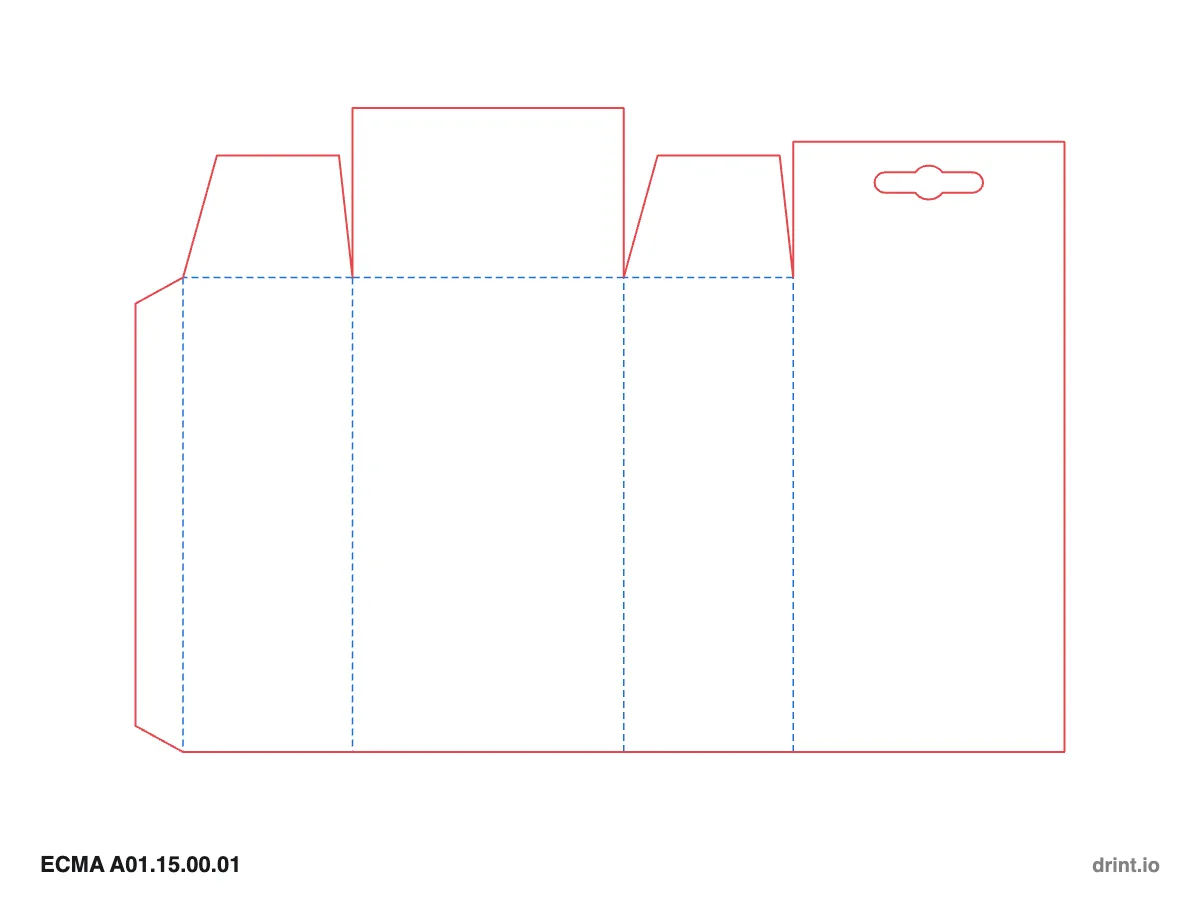
ECMA A01.15.00.01 — Glued with extended back (hang tab) top · open bottom · top on back panel
ECMA A01.15.00.01 is a folding carton (ECMA A-series) whose top is a lid glued down on the dust flaps, the panel the code names running on above it as a hang tab (the lid hinges on the opposite panel) and whose bottom is open. An open bottom makes it a sleeve or tube: it slides over a tray or a product, or is closed by a separate insert. The hang tab lets it hang on a retail peg hook. Drint draws a free ECMA A01.15.00.01 dieline at any size: type the length, width and height and design on it, or download it as PDF or SVG with Pro.
- Code
- ECMA A01.15.00.01
- Standard
- ECMA — folding carton
- Group
- ECMA A01 · Open bottom (sleeves, tubes)
- Drawn at
- 80 × 50 × 140 mm
- Flat sheet
- 274 × 190 mm
- Drawing
- Follows the code’s drawing
In Claude or ChatGPT, add the Drint connector (drint.io/mcp) and ask: “ECMA A01.15.00.01 dieline, 300 × 200 × 100 mm, PDF”.
How it folds
A01.15.00.01 glues the lid down on the front panel (03) and runs the back panel (01) on above the top as a hang tab, and leaves the bottom open. The lid on the front panel (03) is glued down on the two dust flaps, sealing the top for good, while the back panel (01) carries straight on past the top crease into a hang tab with a euro slot, so no extra glued part is needed. On a wide panel the lid at the top folds along the length L and is W deep, opening front-to-back. The open bottom makes it a sleeve or hood: it drops over the product, slides over a tray or base, or is closed later by an insert.
What it is used for
A sealed top with a hang tab suits peg-hook retail of light goods opened once: batteries, small hardware, phone accessories, cosmetic tools and snack packs. With the tab rising from the back panel (01), the front keeps a normal height below the tab and the lid hinge sits on the front edge of the top. With the bottom open it can cap a product or a base tray, or become a tube closed later by an insert.
Blank size by box size
The flat sheet a ECMA A01.15.00.01 needs at each box size, measured on Drint’s own dieline with the board’s thickness allowed for. Add your press’s trim and gripper margin. Each size opens the die in the studio.
| Box, L × W × H | Flat sheet | Sheet area |
|---|---|---|
| 40 × 25 × 70 mm | 144 × 95 mm | 0.01 m² |
| 55 × 35 × 100 mm | 194 × 135 mm | 0.03 m² |
| 80 × 50 × 140 mm | 274 × 190 mm | 0.05 m² |
| 105 × 65 × 180 mm | 354 × 245 mm | 0.09 m² |
| 130 × 80 × 225 mm | 434 × 305 mm | 0.13 m² |
| 160 × 100 × 280 mm | 534 × 380 mm | 0.20 m² |
Measured by Drint’s die engine
These numbers are measured on the ECMA A01.15.00.01 die at 80 × 50 × 140 mm, drawn by the same engine as the studio — not copied from a catalogue.
| Cutting rule | 1.19 m |
|---|---|
| Creasing rule | 0.74 m |
| Total rule per copy | 1.93 m |
| Blank area (board in the box) | 0.049 m² |
| Share of the bounding box used | 93.3% |
| Board per 1,000 blanks (bounding box) | 52 m² |
| Best press sheet | 65 × 86 cm: 9 up, 78.2% of the sheet used |
Parts of this die: Glue flap · Dust flap · Front panel · Side panel · Back panel · Cut-out
Board
Folding boxboard of 250–350 gsm is usual for an open-bottom carton, at the heavier end if it has to keep its shape over a tray or product. The hang tab is a single ply of the panel, so choose a stiff board (around 300 gsm or more) that does not bow under the product on the peg, and keep the dust flaps bare where the lid is glued. Moving the lid between back and front does not change the blank size; with it on the front panel (03) the sheet is as compact as this closure gets.
Printing and die notes
Keep the euro slot and a margin around it clear of text and barcodes, print both faces of the hang tab if its back can be seen on the peg, and leave the dust flaps uncoated where the lid is glued. With the bottom open, the inside of the walls shows when the carton is lifted off, so a white or printed inside looks finished. The tab continues the back panel (01), so it can carry a second message above the front without crowding the main face.
Common mistakes
- Printing over the euro slot, so the punch cuts through text or a barcode.
- Forgetting that the open bottom needs a tray, insert or base, so the product drops out when lifted.
- Making the hang tab from board too light for the product, so it bows forward on the peg.
Questions
What is ECMA A01.15.00.01?
ECMA A01.15.00.01 is a folding carton (ECMA A-series) whose top is a lid glued down on the dust flaps, the panel the code names running on above it as a hang tab (the lid hinges on the opposite panel) and whose bottom is open. An open bottom makes it a sleeve or tube: it slides over a tray or a product, or is closed by a separate insert. The hang tab lets it hang on a retail peg hook.
Where does the hang tab of A01.15.00.01 come from?
It is the back panel (01) carried on above the top crease, with a euro slot cut in it; the lid hinges on the front panel (03) and is glued down on the dust flaps, so the tab stands up clear of the lid.
How does A01.15.00.01 differ from A01.15.00.03?
Here the hang tab rises from the back panel (01) and the lid hinges on the front, so the front keeps its normal height and the tab stands behind it; in A01.15.00.03 the tab grows out of the front, making one tall printed face, and the lid hinges on the back.
What size sheet does a 80 × 50 × 140 mm ECMA A01.15.00.01 need?
A ECMA A01.15.00.01 of 80 × 50 × 140 mm unfolds to a flat sheet of 274 × 190 mm (0.05 m²) on Drint’s dieline, before trim and gripper margins. The table on this page gives the sheet for other sizes; in the studio, type any length, width and height and the sheet is measured again.
How do I get a ECMA A01.15.00.01 dieline at my size?
Open it in Drint and type your length, width and height — inside, on the crease or outside. The die is redrawn at that size with the board’s thickness allowed for, and you design straight on it. In Claude or ChatGPT with the Drint connector, ask for “ECMA A01.15.00.01 dieline” and your size.
What board is ECMA A01.15.00.01 made from?
Folding boxboard of 250–350 gsm is usual for an open-bottom carton, at the heavier end if it has to keep its shape over a tray or product. The hang tab is a single ply of the panel, so choose a stiff board (around 300 gsm or more) that does not bow under the product on the peg, and keep the dust flaps bare where the lid is glued. Moving the lid between back and front does not change the blank size; with it on the front panel (03) the sheet is as compact as this closure gets.
Is the ECMA A01.15.00.01 dieline free?
Designing on the die, the 3D fold and preflight are free in the browser. Downloading the dieline (SVG, PDF / AI, or DXF and CF2 for the die-maker) and the CMYK print PDF needs Pro.