Dielines › Dielines by standard code › FEFCO 0938
FEFCO 0938 — Folded double-wall divider with glue feet
FEFCO 0938 is an interior fitment: a strip of corrugated board folded back on itself into a two-ply wall, with a foot at each free edge for fixing it in a carton or tray. It is used as a strong single divider between two compartments. Drint draws a free FEFCO 0938 dieline at any size: type the length, width and height and design on it, or download it as PDF or SVG with Pro.
- Code
- FEFCO 0938
- Standard
- FEFCO — corrugated board
- Group
- FEFCO 08, 09 · Displays and dividers
- Drawn at
- 300 × 60 × 200 mm
- Flat sheet
- 678 × 200 mm
- Also written
- FEFCO 938
- Drawing
- Follows the code’s drawing
In Claude or ChatGPT, add the Drint connector (drint.io/mcp) and ask: “FEFCO 0938 dieline, 300 × 200 × 100 mm, PDF”.
How it folds
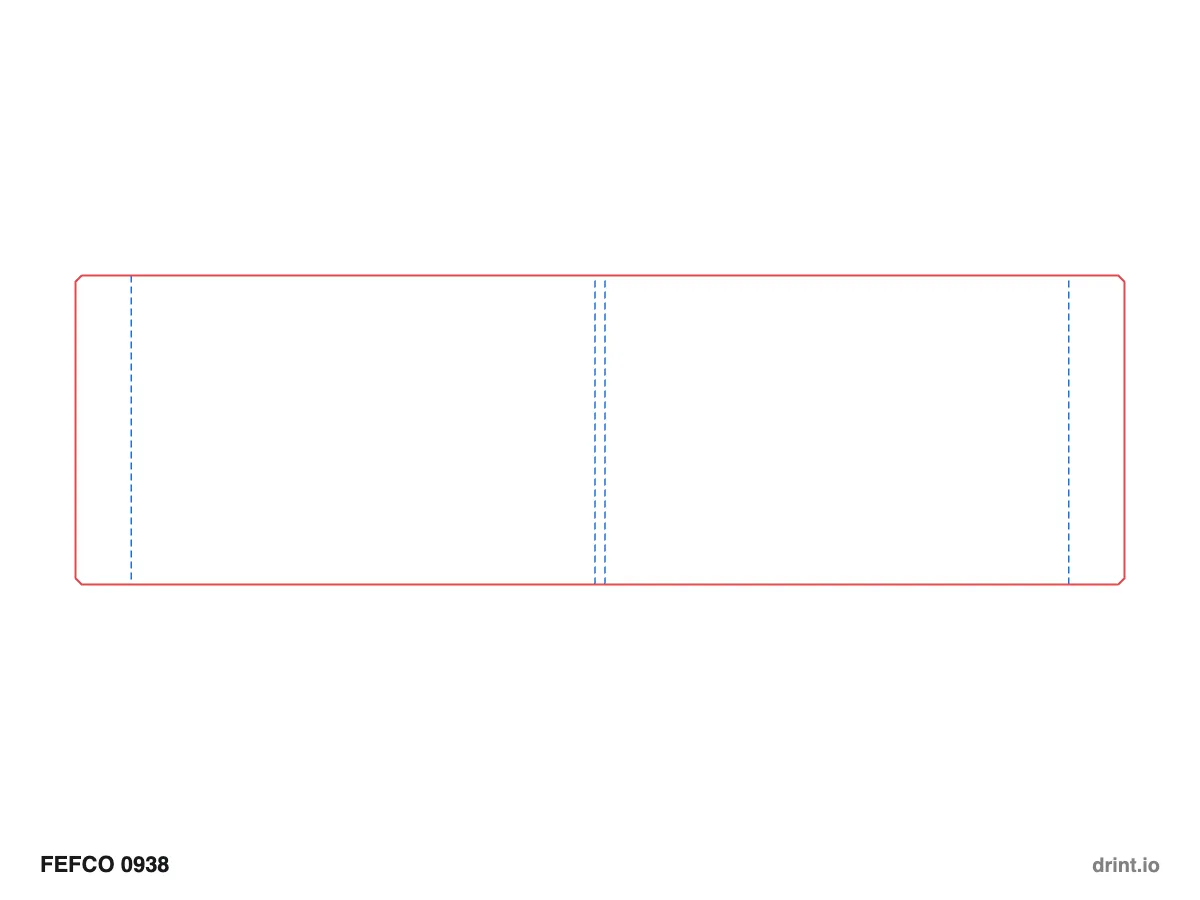
FEFCO 0938 is one rectangular strip with parallel creases only: a first wall panel, a narrow spine, a second wall panel, and a foot at each end. Folding on the spine brings the two wall panels back to back, and the two feet turn outward in opposite directions so the divider stands like an inverted T. The feet are glued or simply pinned down by the goods. A slotted partition such as 0930 is single ply and needs a second piece to stand. Drint's sample is 300 × 60 × 200 mm on a 678 × 200 mm blank.
What it is used for
It splits a carton, tray or display into two compartments for mixed products, sets, or a product and its accessories, and it is used several times side by side to form lanes for bottles or tubes. Two plies make it stiff enough to act as a wall between heavy items.
Blank size by box size
The flat sheet a FEFCO 0938 needs at each box size, measured on Drint’s own dieline with the board’s thickness allowed for. Add your press’s trim and gripper margin. Each size opens the die in the studio.
| Box, L × W × H | Flat sheet | Sheet area |
|---|---|---|
| 150 × 30 × 100 mm | 346 × 100 mm | 0.03 m² |
| 210 × 40 × 140 mm | 477 × 140 mm | 0.07 m² |
| 300 × 60 × 200 mm | 678 × 200 mm | 0.14 m² |
| 390 × 80 × 260 mm | 866 × 260 mm | 0.23 m² |
| 480 × 95 × 320 mm | 1046 × 320 mm | 0.33 m² |
| 600 × 120 × 400 mm | 1286 × 400 mm | 0.51 m² |
Board
B or E flute single wall is usual; the fold already doubles the thickness, so heavy grades are rarely needed. Decide the flute direction before drawing: flutes running across the creases fold cleanly, flutes running parallel to them give a stiffer wall but can crack at the spine.
Printing and die notes
It is normally unprinted, though in an open display tray both faces show and may carry a colour or a product name. Only creasing and straight cuts are needed. Draw the spine as two creases a board thickness apart so the plies lie flat together, and keep feet free of coating if glued.
Common mistakes
- Using a single crease at the spine in thick board, so the two plies spring apart and the divider takes up more space than planned.
- Making the feet too narrow to glue or to be held down by the goods, so the divider tips over when one side is emptied.
- Forgetting that the divider is two boards thick when calculating the width of the compartments on either side.
Mockups on this dieline
Questions
What is FEFCO 0938?
FEFCO 0938 is an interior fitment: a strip of corrugated board folded back on itself into a two-ply wall, with a foot at each free edge for fixing it in a carton or tray. It is used as a strong single divider between two compartments.
Do the feet of a FEFCO 0938 have to be glued?
Not always. In a packed carton the goods standing on the feet keep the divider in place. In a display tray that is emptied by shoppers, or on an automatic line, gluing the feet to the base stops the divider from falling over.
Why fold the divider double instead of using one thick sheet?
The fold gives two plies from thinner board, a smooth rounded top edge with no exposed flute, and feet that come from the same piece. A single thick sheet would need separate brackets or slots to stay upright.
What size sheet does a 300 × 60 × 200 mm FEFCO 0938 need?
A FEFCO 0938 of 300 × 60 × 200 mm unfolds to a flat sheet of 678 × 200 mm (0.14 m²) on Drint’s dieline, before trim and gripper margins. The table on this page gives the sheet for other sizes; in the studio, type any length, width and height and the sheet is measured again.
How do I get a FEFCO 0938 dieline at my size?
Open it in Drint and type your length, width and height — inside, on the crease or outside. The die is redrawn at that size with the board’s thickness allowed for, and you design straight on it. In Claude or ChatGPT with the Drint connector, ask for “FEFCO 0938 dieline” and your size.
What board is FEFCO 0938 made from?
B or E flute single wall is usual; the fold already doubles the thickness, so heavy grades are rarely needed. Decide the flute direction before drawing: flutes running across the creases fold cleanly, flutes running parallel to them give a stiffer wall but can crack at the spine.
Is the FEFCO 0938 dieline free?
Designing on the die, the 3D fold and preflight are free in the browser. Downloading the dieline (SVG, PDF / AI, or DXF and CF2 for the die-maker) and the CMYK print PDF needs Pro.