Dielines › Dielines by standard code › ECMA D20.40.20.00
ECMA D20.40.20.00 — Hexagonal tray with glued corner flaps
ECMA D20.40.20.00 is an open tray on a regular hexagon base with six walls joined by glued corner flaps. Drint draws a free ECMA D20.40.20.00 dieline at any size: type the length, width and height and design on it, or download it as PDF or SVG with Pro.
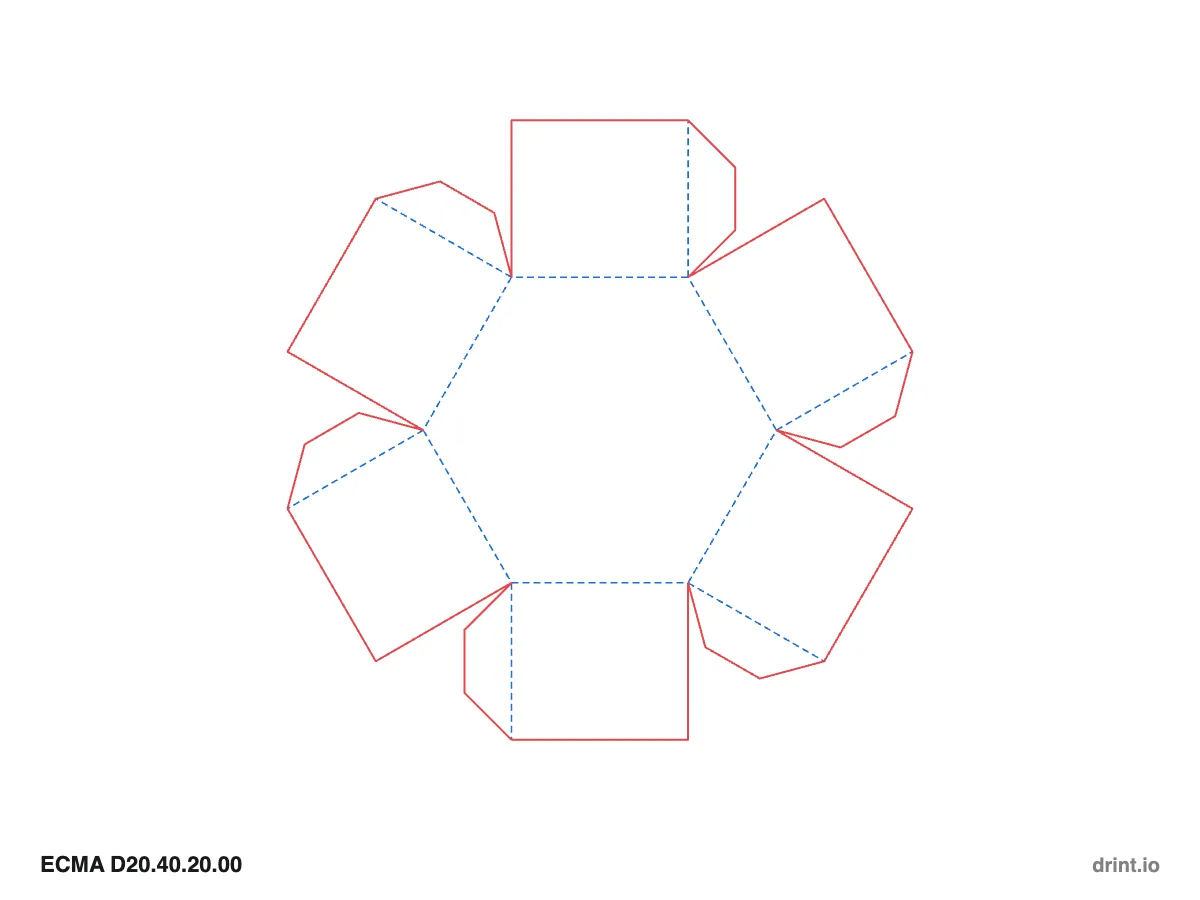
- Code
- ECMA D20.40.20.00
- Standard
- ECMA — folding carton
- Group
- ECMA D · Polygonal trays without a side seam
- Drawn at
- 45 × 60 × 40 mm
- Flat sheet
- 159 × 158 mm
- Also called
- Polygonal tray lục giác glued corner flaps ECMA D20
- Drawing
- Close to the code’s drawing, not exact
In Claude or ChatGPT, add the Drint connector (drint.io/mcp) and ask: “ECMA D20.40.20.00 dieline, 300 × 200 × 100 mm, PDF”.
How it folds
D20.40.20.00 raises six walls from a regular hexagon and closes each corner with a 12 mm glued flap; there is no side seam. Drint's sample has 45 mm sides and 40 mm walls, from a 159.3 × 157.9 mm blank. Drint draws it in its own geometry in the code's style, so check flap sizes with the box maker's drawing.
What it is used for
Honeycomb-themed packs for honey, soap, candles and sweets; trays that tessellate on a display; and the base of a hexagonal lidded gift box. Hexagonal trays also nest neatly in groups inside a larger shipper.
Blank size by box size
The flat sheet a ECMA D20.40.20.00 needs at each box size, measured on Drint’s own dieline with the board’s thickness allowed for. Add your press’s trim and gripper margin. Each size opens the die in the studio.
| Box, L × W × H | Flat sheet | Sheet area |
|---|---|---|
| 25 × 30 × 20 mm | 85 × 83 mm | 0.01 m² |
| 30 × 40 × 30 mm | 112 × 112 mm | 0.01 m² |
| 45 × 60 × 40 mm | 159 × 158 mm | 0.03 m² |
| 60 × 80 × 50 mm | 207 × 204 mm | 0.04 m² |
| 70 × 95 × 65 mm | 253 × 251 mm | 0.06 m² |
| 90 × 120 × 80 mm | 319 × 316 mm | 0.10 m² |
Measured by Drint’s die engine
These numbers are measured on the ECMA D20.40.20.00 die at 45 × 60 × 40 mm, drawn by the same engine as the studio — not copied from a catalogue.
| Cutting rule | 0.81 m |
|---|---|
| Creasing rule | 0.51 m |
| Total rule per copy | 1.32 m |
| Blank area (board in the box) | 0.018 m² |
| Share of the bounding box used | 71.9% |
| Board per 1,000 blanks (bounding box) | 25 m² |
| Best press sheet | 79 × 109 cm: 30 up nested (grid: 24), 63.0% of the sheet used |
Parts of this die: Glue flap · Base panel
Board
Folding boxboard 300–400 gsm; micro-flute E if jars or glass sit in it. Food contact needs a suitable coated grade.
Printing and die notes
Print the inside for open display. Patterns aligned to the six walls look intentional; avoid text across the corners where flaps overlap.
Common mistakes
- Coating the glue zones.
- Sizing to across-corners when the product sits against the flats.
- Forgetting clearance for a lid tray to slide over.
Questions
What is ECMA D20.40.20.00?
ECMA D20.40.20.00 is an open tray on a regular hexagon base with six walls joined by glued corner flaps.
Can hexagonal trays fit together on a shelf?
Yes, hexagons tessellate, so several trays can sit edge to edge.
Is there a hexagonal tray with a lid in this family?
The lid digit is 00 here (no lid); a second, larger tray of the same code can act as a cover.
What size sheet does a 45 × 60 × 40 mm ECMA D20.40.20.00 need?
A ECMA D20.40.20.00 of 45 × 60 × 40 mm unfolds to a flat sheet of 159 × 158 mm (0.03 m²) on Drint’s dieline, before trim and gripper margins. The table on this page gives the sheet for other sizes; in the studio, type any length, width and height and the sheet is measured again.
How do I get a ECMA D20.40.20.00 dieline at my size?
Open it in Drint and type your length, width and height — inside, on the crease or outside. The die is redrawn at that size with the board’s thickness allowed for, and you design straight on it. In Claude or ChatGPT with the Drint connector, ask for “ECMA D20.40.20.00 dieline” and your size.
What board is ECMA D20.40.20.00 made from?
Folding boxboard 300–400 gsm; micro-flute E if jars or glass sit in it. Food contact needs a suitable coated grade.
Is the ECMA D20.40.20.00 dieline free?
Designing on the die, the 3D fold and preflight are free in the browser. Downloading the dieline (SVG, PDF / AI, or DXF and CF2 for the die-maker) and the CMYK print PDF needs Pro.
Is Drint’s ECMA D20.40.20.00 exactly the FEFCO drawing?
Not exactly: Drint draws this code close to the FEFCO drawing. Check the die with your die-maker before production.