Dielines › Dielines by standard code › ECMA D20.10.20.00
ECMA D20.10.20.00 — Triangular tray with glued corner flaps
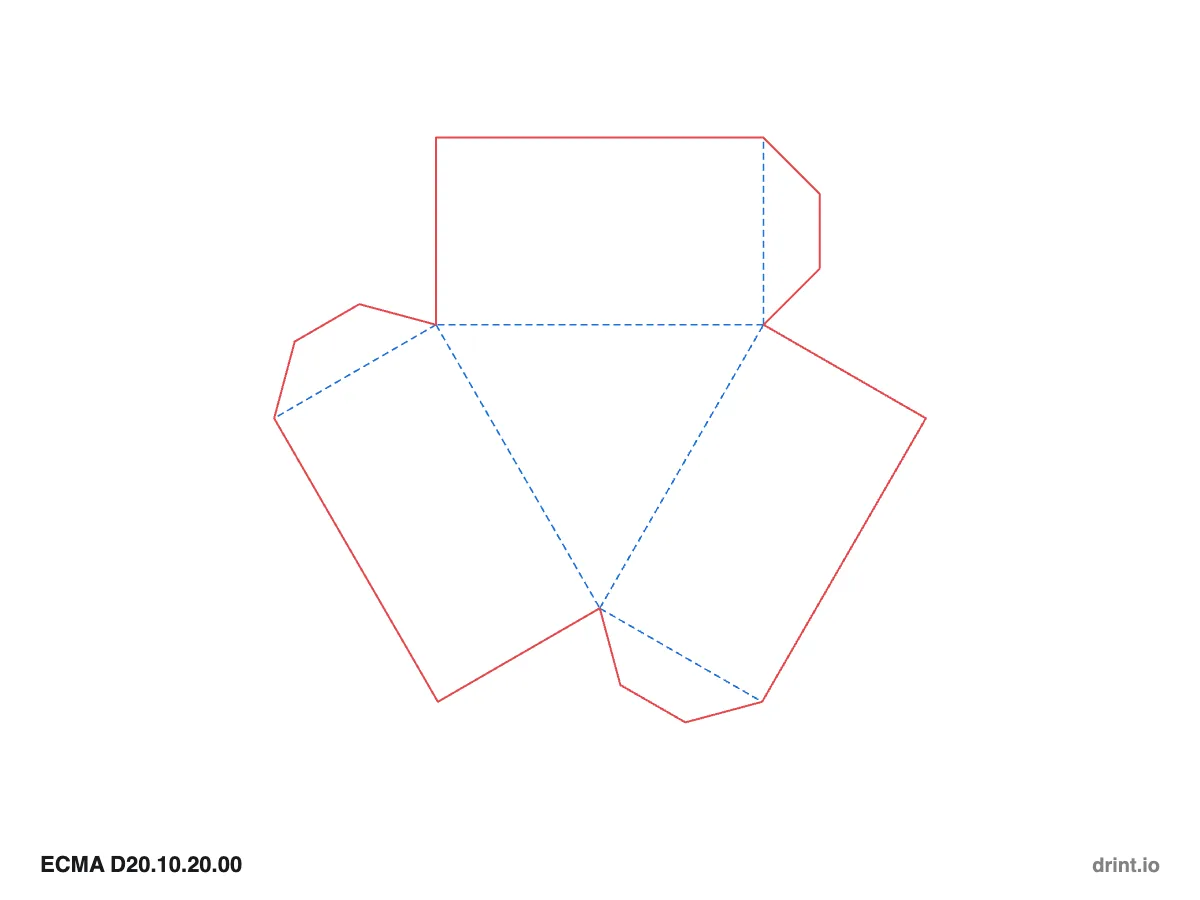
ECMA D20.10.20.00 is an open tray on a triangular base whose three walls are joined by glued corner flaps, with no side seam. Drint draws a free ECMA D20.10.20.00 dieline at any size: type the length, width and height and design on it, or download it as PDF or SVG with Pro.
- Code
- ECMA D20.10.20.00
- Standard
- ECMA — folding carton
- Group
- ECMA D · Polygonal trays without a side seam
- Drawn at
- 70 × 60 × 40 mm
- Flat sheet
- 139 × 125 mm
- Also called
- Polygonal tray tam giác glued corner flaps ECMA D20
- Drawing
- Close to the code’s drawing, not exact
In Claude or ChatGPT, add the Drint connector (drint.io/mcp) and ask: “ECMA D20.10.20.00 dieline, 300 × 200 × 100 mm, PDF”.
How it folds
D20.10.20.00 is a tray made from a single blank without a side seam: three walls fold up from a triangular base and each corner is closed by a 12 mm glue flap stuck to the neighbouring wall. Drint's sample is 40 mm deep on a 70 mm base from a 139.3 × 125 mm blank. The die is Drint's own geometry in the code's style; check flap sizes with the box maker's drawing.
What it is used for
Small display and serving trays: wedges of cheese or cake, sweets, sample cups, accessory trays inside a gift box, or a triangular base under a matching lid. Glued corners make it rigid and ready to fill.
Blank size by box size
The flat sheet a ECMA D20.10.20.00 needs at each box size, measured on Drint’s own dieline with the board’s thickness allowed for. Add your press’s trim and gripper margin. Each size opens the die in the studio.
| Box, L × W × H | Flat sheet | Sheet area |
|---|---|---|
| 35 × 30 × 20 mm | 70 × 63 mm | 0.00 m² |
| 50 × 40 × 30 mm | 102 × 92 mm | 0.01 m² |
| 70 × 60 × 40 mm | 139 × 125 mm | 0.02 m² |
| 90 × 80 × 50 mm | 177 × 157 mm | 0.03 m² |
| 110 × 95 × 65 mm | 223 × 197 mm | 0.04 m² |
| 140 × 120 × 80 mm | 279 × 246 mm | 0.07 m² |
Measured by Drint’s die engine
These numbers are measured on the ECMA D20.10.20.00 die at 70 × 60 × 40 mm, drawn by the same engine as the studio — not copied from a catalogue.
| Cutting rule | 0.48 m |
|---|---|
| Creasing rule | 0.33 m |
| Total rule per copy | 0.81 m |
| Blank area (board in the box) | 0.012 m² |
| Share of the bounding box used | 66.2% |
| Board per 1,000 blanks (bounding box) | 17 m² |
| Best press sheet | 72 × 102 cm: 42 up nested (grid: 35), 65.9% of the sheet used |
Parts of this die: Glue flap · Base panel
Board
Folding boxboard 300–400 gsm; food contact needs a grade approved for the food, and greasy food a coated board. Micro-flute E suits heavier contents.
Printing and die notes
The base and the inside of the walls are the visible faces when filled, so consider printing the inside. Keep varnish off the glue flaps and the wall areas they stick to.
Common mistakes
- Varnishing the corner flap contact areas, so the corners open.
- Printing only the outside when customers see the inside.
- Sizing the triangle to the product's widest point without clearance at the sharp corners.
Questions
What is ECMA D20.10.20.00?
ECMA D20.10.20.00 is an open tray on a triangular base whose three walls are joined by glued corner flaps, with no side seam.
What are glued corner flaps?
Small flaps on the end of each wall that are glued to the next wall, holding the corners without a side seam.
Does D20.10.20.00 have a lid?
No; 00 in the last position means no lid. Use a separate cover or a film.
What size sheet does a 70 × 60 × 40 mm ECMA D20.10.20.00 need?
A ECMA D20.10.20.00 of 70 × 60 × 40 mm unfolds to a flat sheet of 139 × 125 mm (0.02 m²) on Drint’s dieline, before trim and gripper margins. The table on this page gives the sheet for other sizes; in the studio, type any length, width and height and the sheet is measured again.
How do I get a ECMA D20.10.20.00 dieline at my size?
Open it in Drint and type your length, width and height — inside, on the crease or outside. The die is redrawn at that size with the board’s thickness allowed for, and you design straight on it. In Claude or ChatGPT with the Drint connector, ask for “ECMA D20.10.20.00 dieline” and your size.
What board is ECMA D20.10.20.00 made from?
Folding boxboard 300–400 gsm; food contact needs a grade approved for the food, and greasy food a coated board. Micro-flute E suits heavier contents.
Is the ECMA D20.10.20.00 dieline free?
Designing on the die, the 3D fold and preflight are free in the browser. Downloading the dieline (SVG, PDF / AI, or DXF and CF2 for the die-maker) and the CMYK print PDF needs Pro.
Is Drint’s ECMA D20.10.20.00 exactly the FEFCO drawing?
Not exactly: Drint draws this code close to the FEFCO drawing. Check the die with your die-maker before production.