Dielines › Dielines by standard code › ECMA C10.50.01.90
ECMA C10.50.01.90 — Octagonal carton, rosette top, open bottom
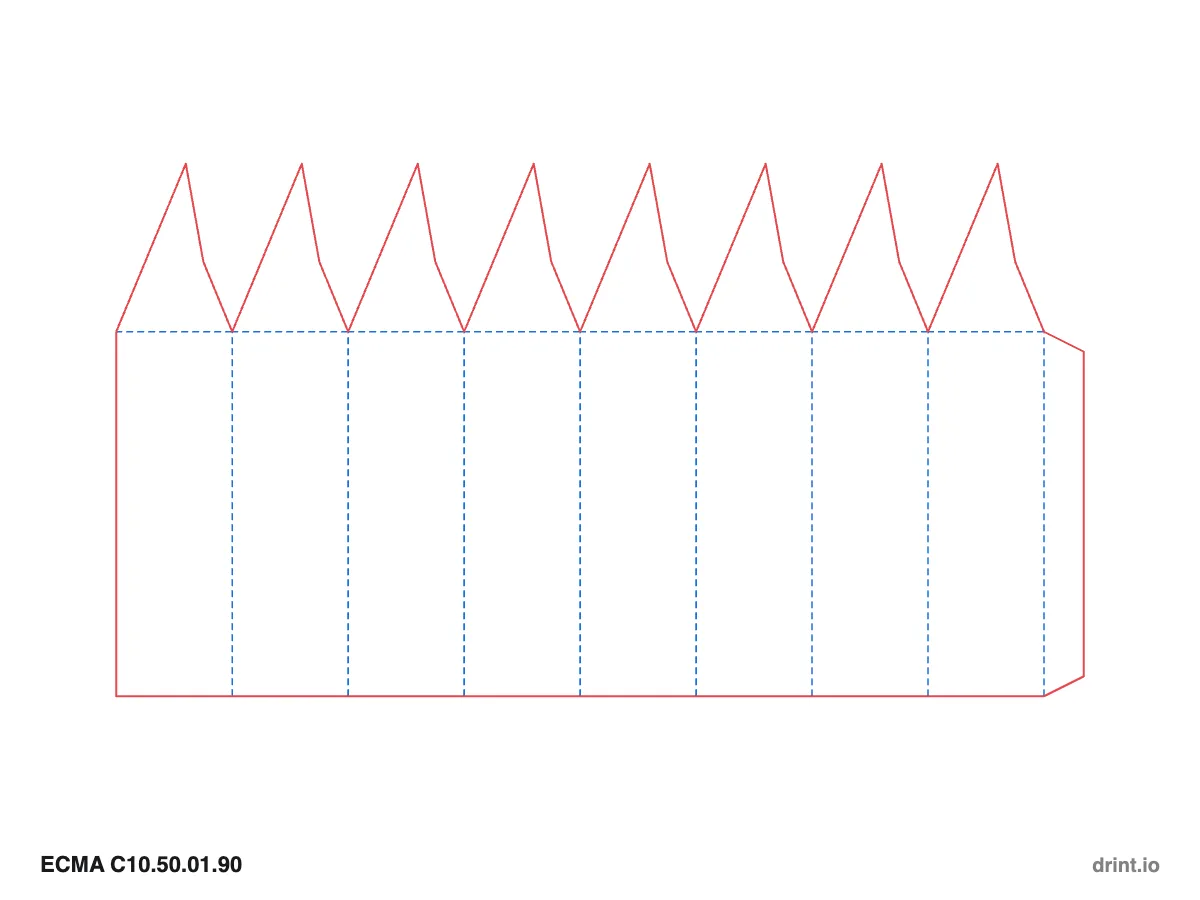
ECMA C10.50.01.90 is a glued eight-sided carton with a twist-lock rosette top and an open bottom. Drint draws a free ECMA C10.50.01.90 dieline at any size: type the length, width and height and design on it, or download it as PDF or SVG with Pro.
- Code
- ECMA C10.50.01.90
- Standard
- ECMA — folding carton
- Group
- ECMA C · Polygonal cartons, glued side seam
- Drawn at
- 35 × 60 × 110 mm
- Flat sheet
- 292 × 161 mm
- Also called
- Polygonal carton bát giác prism glued seam openFlower ECMA C10
- Drawing
- Close to the code’s drawing, not exact
In Claude or ChatGPT, add the Drint connector (drint.io/mcp) and ask: “ECMA C10.50.01.90 dieline, 300 × 200 × 100 mm, PDF”.
How it folds
C10.50.01.90 closes its top with eight interlocking rosette petals and leaves the bottom open. The short petals keep the blank small: Drint's 35 mm-side sample is 84.5 × 84.5 × 110 mm from a 292 × 160.7 mm blank. Drint draws the rosette in its own geometry close to the code's style; check petal shapes against the box maker's drawing.
What it is used for
A decorative octagonal cover over a base, plate or product on a plinth: cake and pastry covers, candle hoods, gift toppers. The rosette top is also a cue that the pack is a present.
Blank size by box size
The flat sheet a ECMA C10.50.01.90 needs at each box size, measured on Drint’s own dieline with the board’s thickness allowed for. Add your press’s trim and gripper margin. Each size opens the die in the studio.
| Box, L × W × H | Flat sheet | Sheet area |
|---|---|---|
| 20 × 30 × 55 mm | 172 × 84 mm | 0.01 m² |
| 25 × 40 × 75 mm | 212 × 111 mm | 0.02 m² |
| 35 × 60 × 110 mm | 292 × 161 mm | 0.05 m² |
| 45 × 80 × 145 mm | 372 × 210 mm | 0.08 m² |
| 55 × 95 × 175 mm | 452 × 255 mm | 0.12 m² |
| 70 × 120 × 220 mm | 572 × 321 mm | 0.18 m² |
Measured by Drint’s die engine
These numbers are measured on the ECMA C10.50.01.90 die at 35 × 60 × 110 mm, drawn by the same engine as the studio — not copied from a catalogue.
| Cutting rule | 1.38 m |
|---|---|
| Creasing rule | 1.16 m |
| Total rule per copy | 2.54 m |
| Blank area (board in the box) | 0.039 m² |
| Share of the bounding box used | 82.2% |
| Board per 1,000 blanks (bounding box) | 47 m² |
| Best press sheet | 65 × 86 cm: 10 up, 69.0% of the sheet used |
Parts of this die: Glue flap · Front panel · Back panel
Board
Folding boxboard 250–350 gsm; petals must flex to lock. A matt surface grips better than a high-gloss laminate.
Printing and die notes
Carry a pattern across all eight petals; a centred logo will be sliced. Side artwork wraps eight faces down to an open cut edge.
Common mistakes
- Centring a logo on the rosette.
- Using board so stiff the petals spring open.
- Forgetting the bottom is open.
Questions
What is ECMA C10.50.01.90?
ECMA C10.50.01.90 is a glued eight-sided carton with a twist-lock rosette top and an open bottom.
Can the rosette top be reclosed?
Yes, it twists open and closed without glue.
Which code has the rosette on the bottom instead?
C10.50.90.01, rosette bottom and open top.
What size sheet does a 35 × 60 × 110 mm ECMA C10.50.01.90 need?
A ECMA C10.50.01.90 of 35 × 60 × 110 mm unfolds to a flat sheet of 292 × 161 mm (0.05 m²) on Drint’s dieline, before trim and gripper margins. The table on this page gives the sheet for other sizes; in the studio, type any length, width and height and the sheet is measured again.
How do I get a ECMA C10.50.01.90 dieline at my size?
Open it in Drint and type your length, width and height — inside, on the crease or outside. The die is redrawn at that size with the board’s thickness allowed for, and you design straight on it. In Claude or ChatGPT with the Drint connector, ask for “ECMA C10.50.01.90 dieline” and your size.
What board is ECMA C10.50.01.90 made from?
Folding boxboard 250–350 gsm; petals must flex to lock. A matt surface grips better than a high-gloss laminate.
Is the ECMA C10.50.01.90 dieline free?
Designing on the die, the 3D fold and preflight are free in the browser. Downloading the dieline (SVG, PDF / AI, or DXF and CF2 for the die-maker) and the CMYK print PDF needs Pro.
Is Drint’s ECMA C10.50.01.90 exactly the FEFCO drawing?
Not exactly: Drint draws this code close to the FEFCO drawing. Check the die with your die-maker before production.