Dielines › Dielines by standard code › ECMA A82.10.00.01
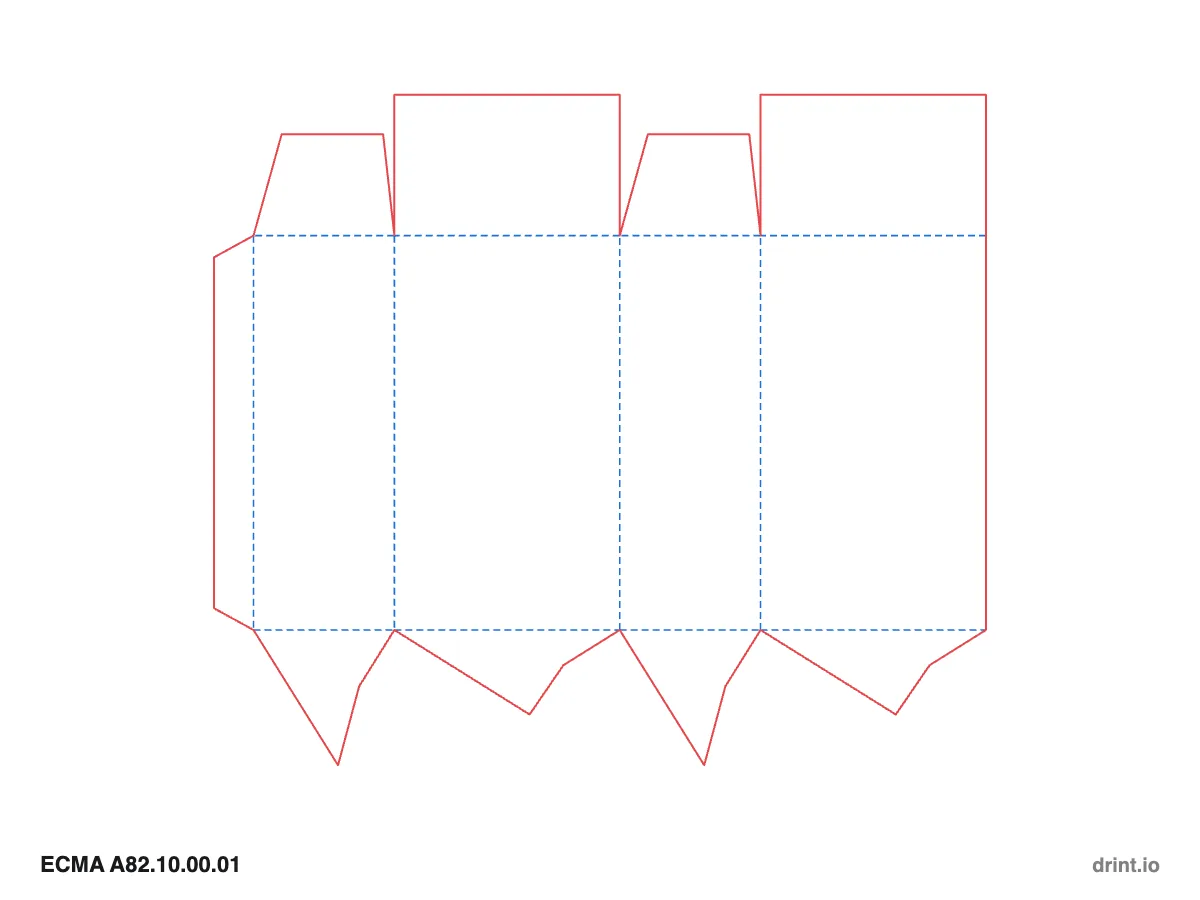
ECMA A82.10.00.01 — Glued full-overlap top · rosette (twist lock) bottom · top on back panel
ECMA A82.10.00.01 is a folding carton (ECMA A-series) whose top is closed by full-overlap glued flaps and whose bottom is a rosette of four flaps that twist and lock into each other, without glue. The rosette bottom locks by twisting its four flaps together, glue-free, and opens again easily — for gift and light retail cartons. Drint draws a free ECMA A82.10.00.01 dieline at any size: type the length, width and height and design on it, or download it as PDF or SVG with Pro.
- Code
- ECMA A82.10.00.01
- Standard
- ECMA — folding carton
- Group
- ECMA A82 · Rosette (twist lock) bottom
- Drawn at
- 80 × 50 × 140 mm
- Flat sheet
- 274 × 238 mm
- Drawing
- Follows the code’s drawing
In Claude or ChatGPT, add the Drint connector (drint.io/mcp) and ask: “ECMA A82.10.00.01 dieline, 300 × 200 × 100 mm, PDF”.
How it folds
In A82.10.00.01 the bottom is a rosette (twist lock): a petal on each of the four panels, each tucked under the next as they twist round, locking without glue; it hangs on no single panel (00). The top is a full-overlap glued end: the outer major flap on the back panel is glued over the inner one on the front panel, each spanning the full depth W, with dust flaps folded under from the side panels. Only the top sets the orientation: hinged on the back, it keeps the front free of hinge lines and opens away from the viewer.
What it is used for
The double glued layer gives a sealed, tamper-evident top for dry food, powders, dishwasher tablets, screws and fixings, and any product that should reach the buyer unopened. The rosette bottom is for light gift and retail goods; it locks without glue and opens again easily, so the carton can be returned flat.
Blank size by box size
The flat sheet a ECMA A82.10.00.01 needs at each box size, measured on Drint’s own dieline with the board’s thickness allowed for. Add your press’s trim and gripper margin. Each size opens the die in the studio.
| Box, L × W × H | Flat sheet | Sheet area |
|---|---|---|
| 40 × 25 × 70 mm | 144 × 119 mm | 0.02 m² |
| 55 × 35 × 100 mm | 194 × 168 mm | 0.03 m² |
| 80 × 50 × 140 mm | 274 × 238 mm | 0.07 m² |
| 105 × 65 × 180 mm | 354 × 308 mm | 0.11 m² |
| 130 × 80 × 225 mm | 434 × 383 mm | 0.17 m² |
| 160 × 100 × 280 mm | 534 × 476 mm | 0.25 m² |
Measured by Drint’s die engine
These numbers are measured on the ECMA A82.10.00.01 die at 80 × 50 × 140 mm, drawn by the same engine as the studio — not copied from a catalogue.
| Cutting rule | 1.30 m |
|---|---|
| Creasing rule | 1.08 m |
| Total rule per copy | 2.38 m |
| Blank area (board in the box) | 0.054 m² |
| Share of the bounding box used | 82.4% |
| Board per 1,000 blanks (bounding box) | 65 m² |
| Best press sheet | 70 × 100 cm: 9 up nested (grid: 8), 69.1% of the sheet used |
Parts of this die: Glue flap · Dust flap · Front panel · Side panel · Back panel
Board
Use 250–350 gsm folding boxboard that bends cleanly at the petals. Leave the glue faces of both major flaps free of varnish and lamination so hot-melt or cold glue can key into the fibre.
Printing and die notes
Only the outer major flap is seen on top; the inner flap and dust flaps are hidden, so keep text off them and leave their glue zones bare. The front reads as a clean full-height panel, so it can carry the main art right up to the top edge.
Common mistakes
- Packing heavy goods in A82.10.00.01: the twist-locked bottom can give way under a dense load where a crash lock or snap lock would hold.
- Laminating the top major flaps all over, so the glue skins off and the lid lifts after a few days.
- Mixing up front and back in the file of A82.10.00.01, so the lid hinge ends up across the top of the display face.
Questions
What is ECMA A82.10.00.01?
ECMA A82.10.00.01 is a folding carton (ECMA A-series) whose top is closed by full-overlap glued flaps and whose bottom is a rosette of four flaps that twist and lock into each other, without glue. The rosette bottom locks by twisting its four flaps together, glue-free, and opens again easily — for gift and light retail cartons.
How is the top of A82.10.00.01 sealed?
Two major flaps that each cover the whole end are glued one over the other, over tucked-in dust flaps. It is opened by tearing and does not reclose.
How strong is the rosette bottom of A82.10.00.01?
It holds light goods well and needs no glue, but it is not meant for heavy or dense products; those need a crash-lock or snap-lock bottom.
What size sheet does a 80 × 50 × 140 mm ECMA A82.10.00.01 need?
A ECMA A82.10.00.01 of 80 × 50 × 140 mm unfolds to a flat sheet of 274 × 238 mm (0.07 m²) on Drint’s dieline, before trim and gripper margins. The table on this page gives the sheet for other sizes; in the studio, type any length, width and height and the sheet is measured again.
How do I get a ECMA A82.10.00.01 dieline at my size?
Open it in Drint and type your length, width and height — inside, on the crease or outside. The die is redrawn at that size with the board’s thickness allowed for, and you design straight on it. In Claude or ChatGPT with the Drint connector, ask for “ECMA A82.10.00.01 dieline” and your size.
What board is ECMA A82.10.00.01 made from?
Use 250–350 gsm folding boxboard that bends cleanly at the petals. Leave the glue faces of both major flaps free of varnish and lamination so hot-melt or cold glue can key into the fibre.
Is the ECMA A82.10.00.01 dieline free?
Designing on the die, the 3D fold and preflight are free in the browser. Downloading the dieline (SVG, PDF / AI, or DXF and CF2 for the die-maker) and the CMYK print PDF needs Pro.