Dielines › Dielines by standard code › ECMA A82.01.00.00
ECMA A82.01.00.00 — Open top · rosette (twist lock) bottom
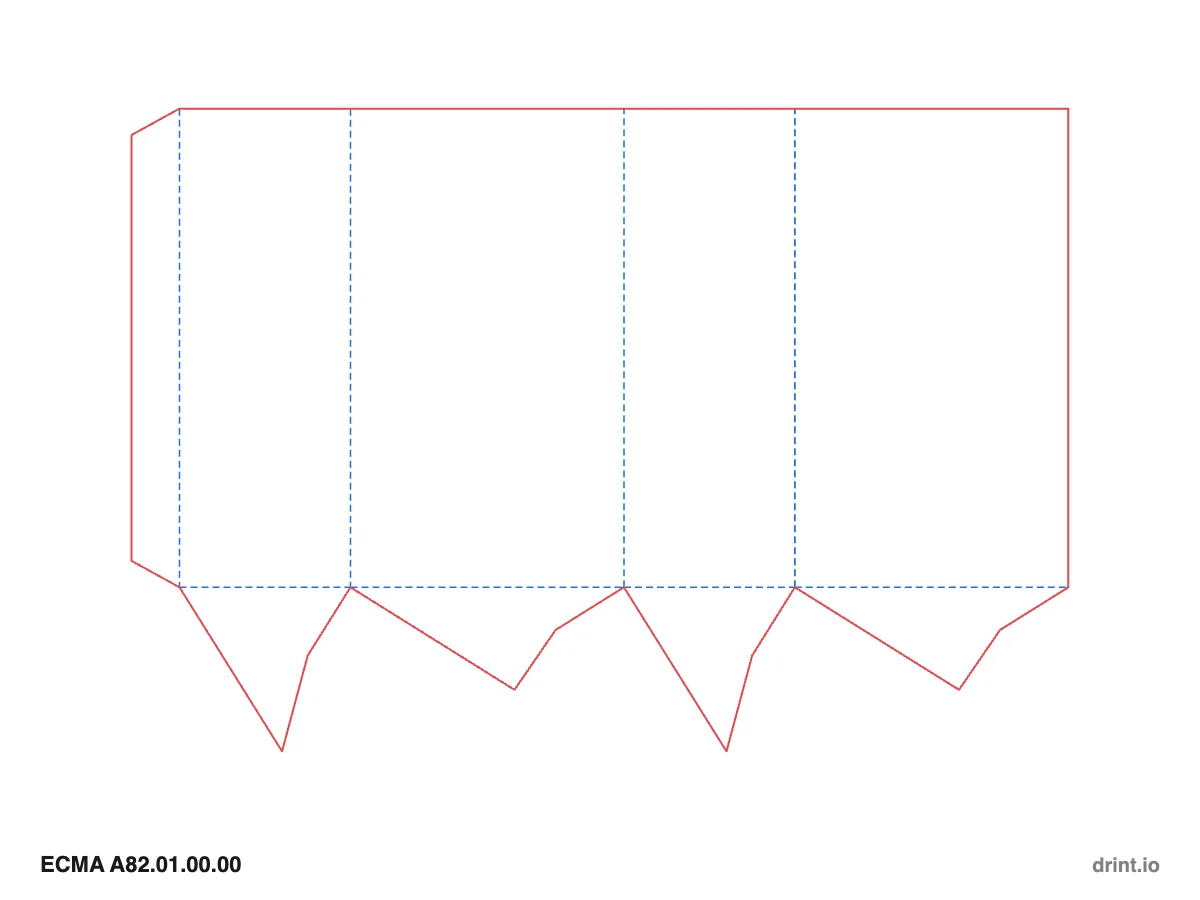
ECMA A82.01.00.00 is a folding carton (ECMA A-series) whose top is open and whose bottom is a rosette of four flaps that twist and lock into each other, without glue. The rosette bottom locks by twisting its four flaps together, glue-free, and opens again easily — for gift and light retail cartons. Drint draws a free ECMA A82.01.00.00 dieline at any size: type the length, width and height and design on it, or download it as PDF or SVG with Pro.
- Code
- ECMA A82.01.00.00
- Standard
- ECMA — folding carton
- Group
- ECMA A82 · Rosette (twist lock) bottom
- Drawn at
- 80 × 50 × 140 mm
- Flat sheet
- 274 × 188 mm
- Drawing
- Follows the code’s drawing
In Claude or ChatGPT, add the Drint connector (drint.io/mcp) and ask: “ECMA A82.01.00.00 dieline, 300 × 200 × 100 mm, PDF”.
How it folds
In A82.01.00.00 the bottom is a rosette (twist lock): a petal on each of the four panels, each tucked under the next as they twist round, locking without glue; it hangs on no single panel (00). The top is left open: the four panels simply end at the top crease line, so A82.01.00.00 is a cup or tube filled from above and closed by a separate lid, film, sleeve or the product itself. Neither end hangs on a single panel, so the carton has no fixed opening side and any face can serve as the front.
What it is used for
It works as an inner cup or display base: a holder for a candle or plant pot, an inner for a jar that a sleeve or lid slides over, or a tray that shows the product from above. The rosette bottom is for light gift and retail goods; it locks without glue and opens again easily, so the carton can be returned flat.
Blank size by box size
The flat sheet a ECMA A82.01.00.00 needs at each box size, measured on Drint’s own dieline with the board’s thickness allowed for. Add your press’s trim and gripper margin. Each size opens the die in the studio.
| Box, L × W × H | Flat sheet | Sheet area |
|---|---|---|
| 40 × 25 × 70 mm | 144 × 94 mm | 0.01 m² |
| 55 × 35 × 100 mm | 194 × 133 mm | 0.03 m² |
| 80 × 50 × 140 mm | 274 × 188 mm | 0.05 m² |
| 105 × 65 × 180 mm | 354 × 243 mm | 0.09 m² |
| 130 × 80 × 225 mm | 434 × 303 mm | 0.13 m² |
| 160 × 100 × 280 mm | 534 × 376 mm | 0.20 m² |
Measured by Drint’s die engine
These numbers are measured on the ECMA A82.01.00.00 die at 80 × 50 × 140 mm, drawn by the same engine as the studio — not copied from a catalogue.
| Cutting rule | 0.98 m |
|---|---|
| Creasing rule | 0.82 m |
| Total rule per copy | 1.80 m |
| Blank area (board in the box) | 0.043 m² |
| Share of the bounding box used | 82.8% |
| Board per 1,000 blanks (bounding box) | 52 m² |
| Best press sheet | 72 × 102 cm: 12 up nested (grid: 10), 69.7% of the sheet used |
Parts of this die: Glue flap · Front panel · Side panel · Back panel
Board
Use 250–350 gsm folding boxboard that bends cleanly at the petals. With no top flaps to brace the walls, the rim relies on board stiffness alone, so stay at 300–400 gsm folding boxboard for anything taller than it is wide.
Printing and die notes
The inside of the walls is visible from above, so specify a white or printed reverse and run the outside art right up to the rim. With no fixed front, it is easy to print four equal faces, for example a repeating pattern or a different flavour on each side.
Common mistakes
- Packing heavy goods in A82.01.00.00: the twist-locked bottom can give way under a dense load where a crash lock or snap lock would hold.
- Forgetting that the open rim needs a lid or sleeve sized to it, so the outer part is designed later and does not fit.
- Bleeding the outside art short of the rim, leaving a thin unprinted band around the top edge.
Questions
What is ECMA A82.01.00.00?
ECMA A82.01.00.00 is a folding carton (ECMA A-series) whose top is open and whose bottom is a rosette of four flaps that twist and lock into each other, without glue. The rosette bottom locks by twisting its four flaps together, glue-free, and opens again easily — for gift and light retail cartons.
How do you close the top of A82.01.00.00?
You do not: the top is open by design. It is closed by a separate lid, film or sleeve, or used open as a cup or base.
How strong is the rosette bottom of A82.01.00.00?
It holds light goods well and needs no glue, but it is not meant for heavy or dense products; those need a crash-lock or snap-lock bottom.
What size sheet does a 80 × 50 × 140 mm ECMA A82.01.00.00 need?
A ECMA A82.01.00.00 of 80 × 50 × 140 mm unfolds to a flat sheet of 274 × 188 mm (0.05 m²) on Drint’s dieline, before trim and gripper margins. The table on this page gives the sheet for other sizes; in the studio, type any length, width and height and the sheet is measured again.
How do I get a ECMA A82.01.00.00 dieline at my size?
Open it in Drint and type your length, width and height — inside, on the crease or outside. The die is redrawn at that size with the board’s thickness allowed for, and you design straight on it. In Claude or ChatGPT with the Drint connector, ask for “ECMA A82.01.00.00 dieline” and your size.
What board is ECMA A82.01.00.00 made from?
Use 250–350 gsm folding boxboard that bends cleanly at the petals. With no top flaps to brace the walls, the rim relies on board stiffness alone, so stay at 300–400 gsm folding boxboard for anything taller than it is wide.
Is the ECMA A82.01.00.00 dieline free?
Designing on the die, the 3D fold and preflight are free in the browser. Downloading the dieline (SVG, PDF / AI, or DXF and CF2 for the die-maker) and the CMYK print PDF needs Pro.