Dielines › Dielines by standard code › ECMA A11.82.01.00
ECMA A11.82.01.00 — Rosette (twist lock) top · glued reduced-flap bottom · bottom on back panel
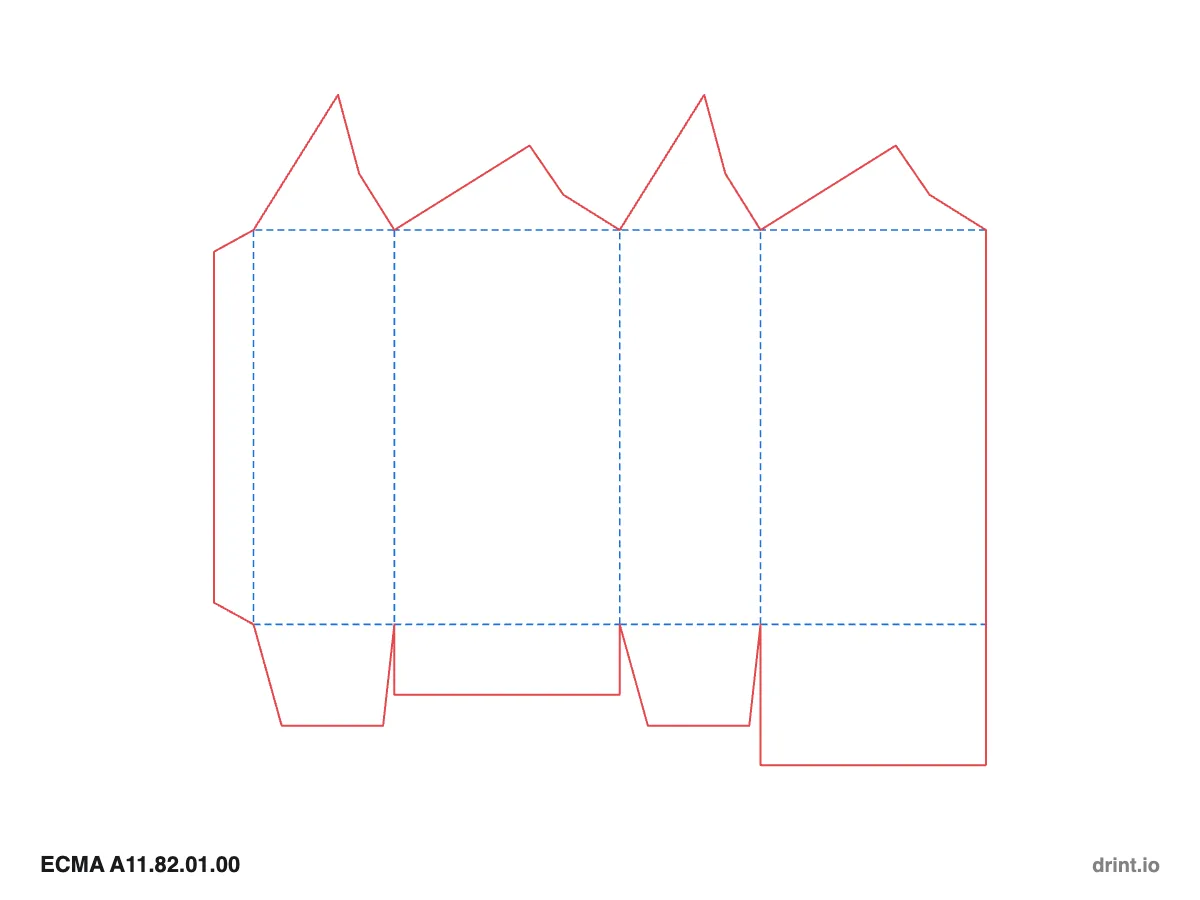
ECMA A11.82.01.00 is a folding carton (ECMA A-series) whose top is a rosette of four flaps that twist and lock into each other, without glue and whose bottom is closed by glued flaps, one long and one short. The glued bottom with one long and one short flap is sealed on the gluing line and saves board. Drint draws a free ECMA A11.82.01.00 dieline at any size: type the length, width and height and design on it, or download it as PDF or SVG with Pro.
- Code
- ECMA A11.82.01.00
- Standard
- ECMA — folding carton
- Group
- ECMA A10, A11 · Glued flap bottom
- Drawn at
- 80 × 50 × 140 mm
- Flat sheet
- 274 × 238 mm
- Drawing
- Follows the code’s drawing
In Claude or ChatGPT, add the Drint connector (drint.io/mcp) and ask: “ECMA A11.82.01.00 dieline, 300 × 200 × 100 mm, PDF”.
How it folds
In A11.82.01.00, the top is a rosette (twist lock): a petal on each of the four panels, each tucked under the next as they twist round, so the end hangs on no single panel (00). The bottom is a reduced-flap glued end: a full-depth outer flap on the back panel is glued over a short, roughly half-depth inner flap on the front panel, with dust flaps on the two side panels folded in underneath. Hinged on a wide panel, the outer flap runs along the length L and is W deep, the compact, usual layout.
What it is used for
The twisted rosette makes a decorative, reclosable top for gifts, candles, tea, sweets and cosmetics, opened and closed without glue. The glued base is set on the gluer or by hand before filling and carries more than a tuck bottom, while the short inner flap saves board over a full overlap. With the base flap on the back panel, the bottom keeps the usual compact layout.
Blank size by box size
The flat sheet a ECMA A11.82.01.00 needs at each box size, measured on Drint’s own dieline with the board’s thickness allowed for. Add your press’s trim and gripper margin. Each size opens the die in the studio.
| Box, L × W × H | Flat sheet | Sheet area |
|---|---|---|
| 40 × 25 × 70 mm | 144 × 119 mm | 0.02 m² |
| 55 × 35 × 100 mm | 194 × 168 mm | 0.03 m² |
| 80 × 50 × 140 mm | 274 × 238 mm | 0.07 m² |
| 105 × 65 × 180 mm | 354 × 308 mm | 0.11 m² |
| 130 × 80 × 225 mm | 434 × 383 mm | 0.17 m² |
| 160 × 100 × 280 mm | 534 × 476 mm | 0.25 m² |
Measured by Drint’s die engine
These numbers are measured on the ECMA A11.82.01.00 die at 80 × 50 × 140 mm, drawn by the same engine as the studio — not copied from a catalogue.
| Cutting rule | 1.25 m |
|---|---|
| Creasing rule | 1.08 m |
| Total rule per copy | 2.33 m |
| Blank area (board in the box) | 0.052 m² |
| Share of the bounding box used | 79.4% |
| Board per 1,000 blanks (bounding box) | 65 m² |
| Best press sheet | 72 × 102 cm: 9 up nested (grid: 8), 63.4% of the sheet used |
Parts of this die: Glue flap · Dust flap · Front panel · Side panel · Back panel
Board
Folding boxboard 300–350 gsm with a smooth surface gives petals that spring back into the twist; very thick or fluted board makes the rosette hard to close. Leave the glue areas uncoated, with no varnish or lamination, so hot-melt or cold glue can bond. The tuck or lock needs crisp, well-matched creases, so check the crease rule against the board caliper.
Printing and die notes
Keep varnish and lamination off the glue zones of the outer and inner bottom flaps; the outer flap on the back panel is a good place for batch codes and recycling marks. Each petal sits at 90° to the next, so rotate any text or motif per petal and design the centre where the tips meet. The back panel meets the glue joint, so its bottom flap ends at the corner where the glue flap doubles the board; relieve that flap edge slightly.
Common mistakes
- Packing goods heavier than a reduced-flap glued base suits instead of moving to a crash-lock bottom.
- Printing all petals the same way up, so text reads sideways or upside down on three of them.
- Making the petals too short, so a hole is left in the centre and the twist does not lock.
Questions
What is ECMA A11.82.01.00?
ECMA A11.82.01.00 is a folding carton (ECMA A-series) whose top is a rosette of four flaps that twist and lock into each other, without glue and whose bottom is closed by glued flaps, one long and one short. The glued bottom with one long and one short flap is sealed on the gluing line and saves board.
What does the code A11.82.01.00 mean?
A11 is the bottom (reduced-flap glued bottom) and 82 the top (rosette twist-lock top); the bottom hangs on the back panel (01) and the top hangs on no single panel (00).
Can A11.82.01.00 be opened and closed again?
The top can, since it locks without glue; the glued bottom stays sealed.
What size sheet does a 80 × 50 × 140 mm ECMA A11.82.01.00 need?
A ECMA A11.82.01.00 of 80 × 50 × 140 mm unfolds to a flat sheet of 274 × 238 mm (0.07 m²) on Drint’s dieline, before trim and gripper margins. The table on this page gives the sheet for other sizes; in the studio, type any length, width and height and the sheet is measured again.
How do I get a ECMA A11.82.01.00 dieline at my size?
Open it in Drint and type your length, width and height — inside, on the crease or outside. The die is redrawn at that size with the board’s thickness allowed for, and you design straight on it. In Claude or ChatGPT with the Drint connector, ask for “ECMA A11.82.01.00 dieline” and your size.
What board is ECMA A11.82.01.00 made from?
Folding boxboard 300–350 gsm with a smooth surface gives petals that spring back into the twist; very thick or fluted board makes the rosette hard to close. Leave the glue areas uncoated, with no varnish or lamination, so hot-melt or cold glue can bond. The tuck or lock needs crisp, well-matched creases, so check the crease rule against the board caliper.
Is the ECMA A11.82.01.00 dieline free?
Designing on the die, the 3D fold and preflight are free in the browser. Downloading the dieline (SVG, PDF / AI, or DXF and CF2 for the die-maker) and the CMYK print PDF needs Pro.