Dielines › Dielines by standard code › ECMA A11.55.01.03
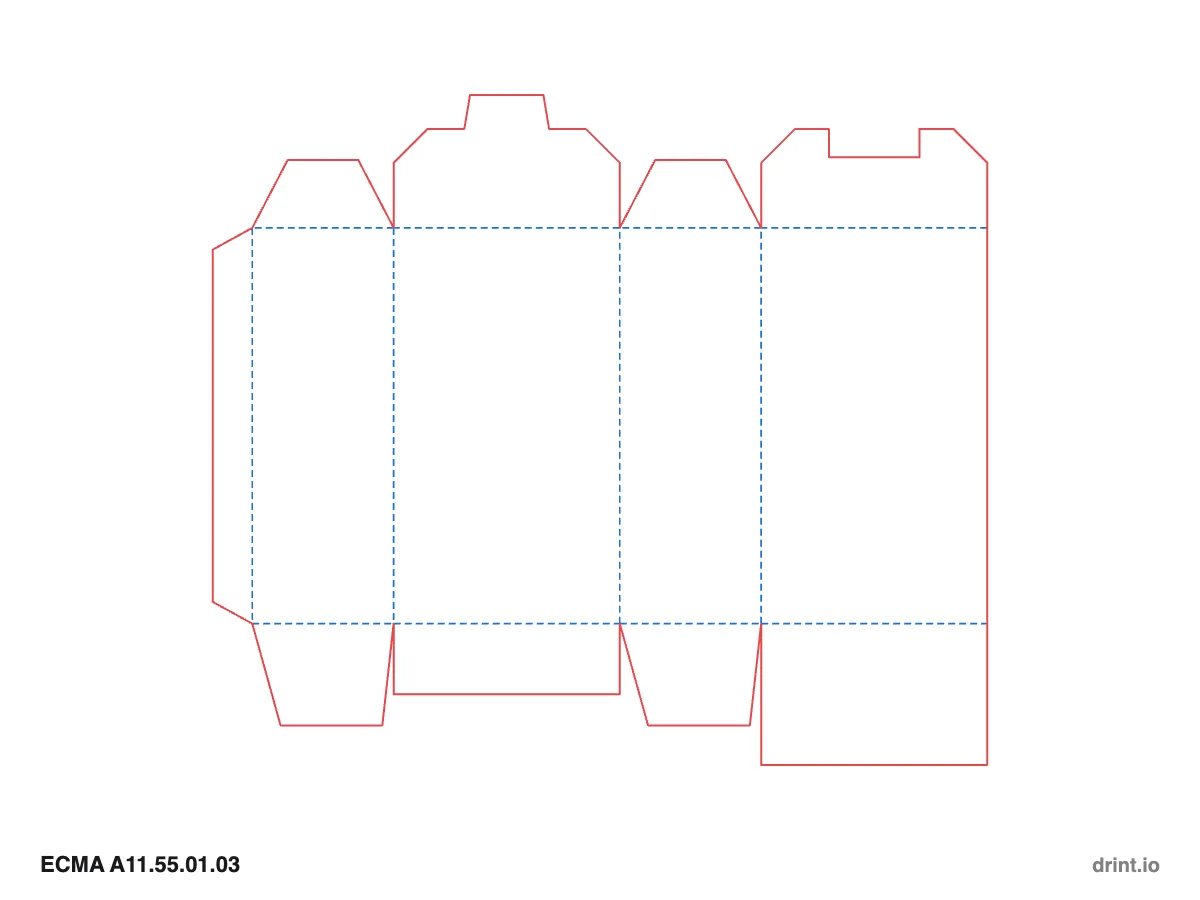
ECMA A11.55.01.03 — Snap lock (1-2-3) top · glued reduced-flap bottom · opposite sides
ECMA A11.55.01.03 is a folding carton (ECMA A-series) whose top is a 1-2-3 snap lock and whose bottom is closed by glued flaps, one long and one short, hinged on opposite panels. The glued bottom with one long and one short flap is sealed on the gluing line and saves board. Drint draws a free ECMA A11.55.01.03 dieline at any size: type the length, width and height and design on it, or download it as PDF or SVG with Pro.
- Code
- ECMA A11.55.01.03
- Standard
- ECMA — folding carton
- Group
- ECMA A10, A11 · Glued flap bottom
- Drawn at
- 80 × 50 × 140 mm
- Flat sheet
- 274 × 237 mm
- Drawing
- Follows the code’s drawing
In Claude or ChatGPT, add the Drint connector (drint.io/mcp) and ask: “ECMA A11.55.01.03 dieline, 300 × 200 × 100 mm, PDF”.
How it folds
In A11.55.01.03, the top is a double snap lock (1-2-3) end keyed to the front panel: four interlocking flaps, folded by hand in sequence, lock each other without glue. The bottom is a reduced-flap glued end: a full-depth outer flap on the back panel is glued over a short, roughly half-depth inner flap on the front panel, with dust flaps on the two side panels folded in underneath. Hinged on a wide panel, the outer flap runs along the length L and is W deep, the compact, usual layout. The two ends hang on opposite panels, like a reverse tuck end, so blanks nest top-to-bottom on the sheet and run well on gluers and cartoners; the closures open from opposite faces.
What it is used for
The locked top holds when the carton is stacked, carried or turned over, yet opens without tearing; it suits jars, hardware, candles and heavier gift items packed by hand. The glued base is set on the gluer or by hand before filling and carries more than a tuck bottom, while the short inner flap saves board over a full overlap. Hinged on the front, the lid swings away toward the back, so the front art can run over the top fold and the opening edge stays out of sight on the shelf.
Blank size by box size
The flat sheet a ECMA A11.55.01.03 needs at each box size, measured on Drint’s own dieline with the board’s thickness allowed for. Add your press’s trim and gripper margin. Each size opens the die in the studio.
| Box, L × W × H | Flat sheet | Sheet area |
|---|---|---|
| 40 × 25 × 70 mm | 144 × 119 mm | 0.02 m² |
| 55 × 35 × 100 mm | 194 × 169 mm | 0.03 m² |
| 80 × 50 × 140 mm | 274 × 237 mm | 0.06 m² |
| 105 × 65 × 180 mm | 354 × 306 mm | 0.11 m² |
| 130 × 80 × 225 mm | 434 × 377 mm | 0.16 m² |
| 160 × 100 × 280 mm | 534 × 462 mm | 0.25 m² |
Measured by Drint’s die engine
These numbers are measured on the ECMA A11.55.01.03 die at 80 × 50 × 140 mm, drawn by the same engine as the studio — not copied from a catalogue.
| Cutting rule | 1.30 m |
|---|---|
| Creasing rule | 1.08 m |
| Total rule per copy | 2.38 m |
| Blank area (board in the box) | 0.054 m² |
| Share of the bounding box used | 83.9% |
| Board per 1,000 blanks (bounding box) | 65 m² |
| Best press sheet | 70 × 100 cm: 9 up nested (grid: 8), 70.0% of the sheet used |
Parts of this die: Glue flap · Dust flap · Snap-lock bottom · Front panel · Side panel · Back panel
Board
Folding boxboard 300–400 gsm gives the snap-lock top enough stiffness to hold its lock; E-flute micro-flute suits heavier goods. Leave the glue areas uncoated, with no varnish or lamination, so hot-melt or cold glue can bond. The tuck or lock needs crisp, well-matched creases, so check the crease rule against the board caliper.
Printing and die notes
Keep varnish and lamination off the glue zones of the outer and inner bottom flaps; the outer flap on the back panel is a good place for batch codes and recycling marks. The locked top is a patchwork of four flaps, so keep important art off it and print the main flap only with something that survives being split by lock cuts. The back panel meets the glue joint, so its bottom flap ends at the corner where the glue flap doubles the board; relieve that flap edge slightly.
Common mistakes
- Varnishing or laminating over the glue zones of the bottom flaps, so the base lets go under load.
- Glueing the snap-lock top or cutting the lock without clearance, so it cannot be folded by hand.
- Reading the artwork for both ends one way up; with the ends on opposite panels one end's flap text must be turned 180°.
Questions
What is ECMA A11.55.01.03?
ECMA A11.55.01.03 is a folding carton (ECMA A-series) whose top is a 1-2-3 snap lock and whose bottom is closed by glued flaps, one long and one short, hinged on opposite panels. The glued bottom with one long and one short flap is sealed on the gluing line and saves board.
What does the code A11.55.01.03 mean?
A11 is the bottom (reduced-flap glued bottom) and 55 the top (double snap lock top); the bottom hangs on the back panel (01) and the top hangs on the front panel (03).
Can A11.55.01.03 be opened and closed again?
The top can, since it locks without glue; the glued bottom stays sealed.
What size sheet does a 80 × 50 × 140 mm ECMA A11.55.01.03 need?
A ECMA A11.55.01.03 of 80 × 50 × 140 mm unfolds to a flat sheet of 274 × 237 mm (0.06 m²) on Drint’s dieline, before trim and gripper margins. The table on this page gives the sheet for other sizes; in the studio, type any length, width and height and the sheet is measured again.
How do I get a ECMA A11.55.01.03 dieline at my size?
Open it in Drint and type your length, width and height — inside, on the crease or outside. The die is redrawn at that size with the board’s thickness allowed for, and you design straight on it. In Claude or ChatGPT with the Drint connector, ask for “ECMA A11.55.01.03 dieline” and your size.
What board is ECMA A11.55.01.03 made from?
Folding boxboard 300–400 gsm gives the snap-lock top enough stiffness to hold its lock; E-flute micro-flute suits heavier goods. Leave the glue areas uncoated, with no varnish or lamination, so hot-melt or cold glue can bond. The tuck or lock needs crisp, well-matched creases, so check the crease rule against the board caliper.
Is the ECMA A11.55.01.03 dieline free?
Designing on the die, the 3D fold and preflight are free in the browser. Downloading the dieline (SVG, PDF / AI, or DXF and CF2 for the die-maker) and the CMYK print PDF needs Pro.