Dielines › Dielines by standard code › ECMA A10.11.02.04
ECMA A10.11.02.04 — Glued reduced-flap top · glued full-overlap bottom · top on left side, bottom on right side panel
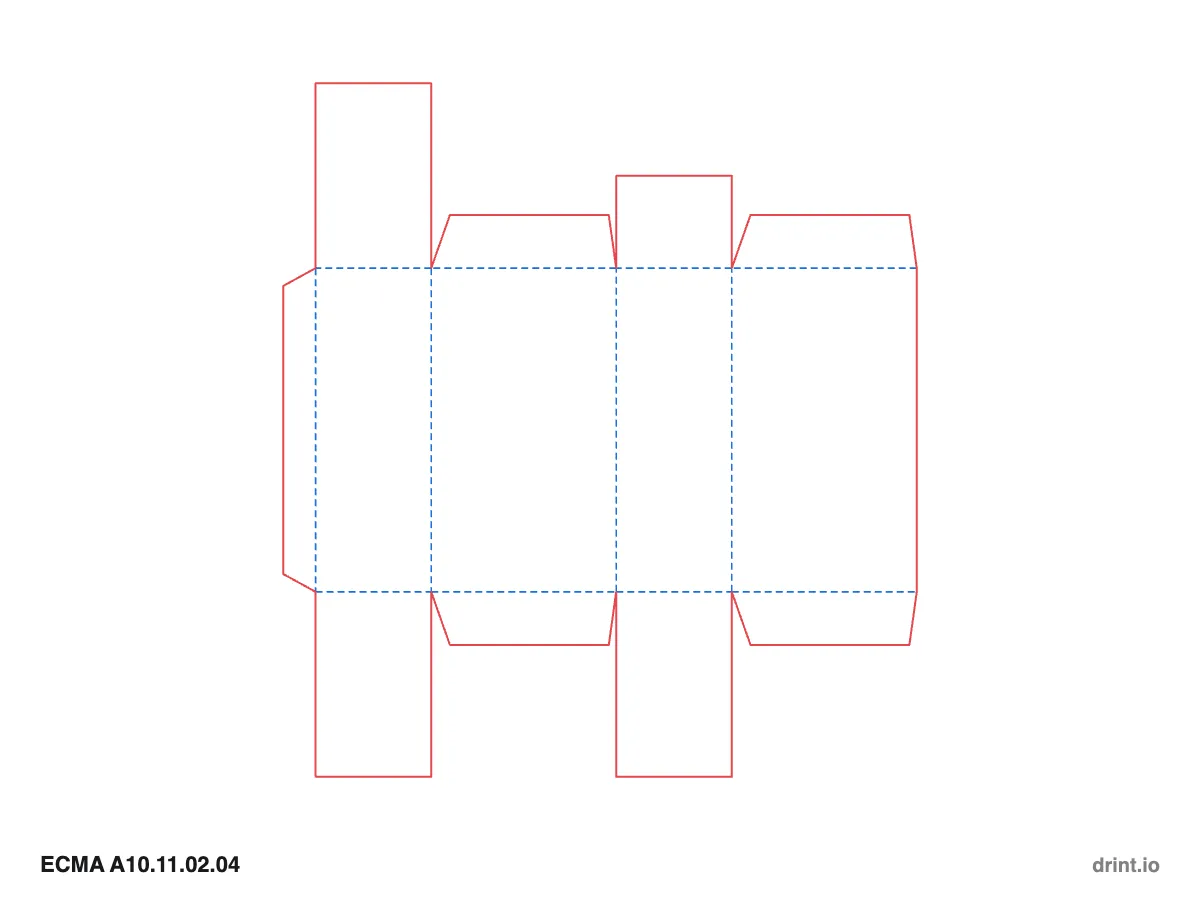
ECMA A10.11.02.04 is a folding carton (ECMA A-series) whose top is closed by glued flaps, one long and one short and whose bottom is closed by full-overlap glued flaps, the top hinged on the left side panel and the bottom on the right side panel. The glued full-overlap bottom is sealed on the gluing line and carries heavier contents than a tuck. Drint draws a free ECMA A10.11.02.04 dieline at any size: type the length, width and height and design on it, or download it as PDF or SVG with Pro.
- Code
- ECMA A10.11.02.04
- Standard
- ECMA — folding carton
- Group
- ECMA A10, A11 · Glued flap bottom
- Drawn at
- 80 × 50 × 140 mm
- Flat sheet
- 274 × 300 mm
- Drawing
- Follows the code’s drawing
In Claude or ChatGPT, add the Drint connector (drint.io/mcp) and ask: “ECMA A10.11.02.04 dieline, 300 × 200 × 100 mm, PDF”.
How it folds
A10.11.02.04 closes the top with reduced glued flaps (one long, one short) hinged on the left side panel (04), and seals the bottom with full-overlap glued flaps hinged on the right side panel (02). At the top one full-depth outer flap is glued over a short inner flap about half the depth, with the dust flaps underneath; the outer flap still closes the whole end while the short one saves board. Both closures hang on side panels, so each folds along the width W and is L deep: they open side-to-side and the dust flaps move to the front and back panels. Top and bottom hinge on opposite panels, as in a reverse tuck end, so the dies nest head-to-tail on the sheet and the blank runs well on gluers and cartoners.
What it is used for
The reduced-flap glued top seals light goods while saving board on the inner flap: tea bags, dry pasta, small hardware, sachets and single-use items. With the lid on the left side panel (04) it lifts from the right edge and opens side-to-side, which suits long narrow products slid in from the end, cartons displayed end-on, and fronts that must stay unbroken by a hinge line. The glued bottom on the right side panel (02) is sealed on the gluing line or cartoner and carries a few hundred grams to around 1 kg.
Blank size by box size
The flat sheet a ECMA A10.11.02.04 needs at each box size, measured on Drint’s own dieline with the board’s thickness allowed for. Add your press’s trim and gripper margin. Each size opens the die in the studio.
| Box, L × W × H | Flat sheet | Sheet area |
|---|---|---|
| 40 × 25 × 70 mm | 144 × 150 mm | 0.02 m² |
| 55 × 35 × 100 mm | 194 × 210 mm | 0.04 m² |
| 80 × 50 × 140 mm | 274 × 300 mm | 0.08 m² |
| 105 × 65 × 180 mm | 354 × 390 mm | 0.14 m² |
| 130 × 80 × 225 mm | 434 × 485 mm | 0.21 m² |
| 160 × 100 × 280 mm | 534 × 600 mm | 0.32 m² |
Measured by Drint’s die engine
These numbers are measured on the ECMA A10.11.02.04 die at 80 × 50 × 140 mm, drawn by the same engine as the studio — not copied from a catalogue.
| Cutting rule | 1.52 m |
|---|---|
| Creasing rule | 1.08 m |
| Total rule per copy | 2.60 m |
| Blank area (board in the box) | 0.059 m² |
| Share of the bounding box used | 71.9% |
| Board per 1,000 blanks (bounding box) | 82 m² |
| Best press sheet | 65 × 86 cm: 6 up, 63.4% of the sheet used |
Parts of this die: Glue flap · Dust flap · Front panel · Side panel · Back panel
Board
Folding boxboard of 300–400 gsm suits the glued bottom, with E-flute micro-flute for glass or heavier goods; leave the overlapping bottom flaps on the right side panel (02) and its opposite panel free of varnish and lamination where the glue lands. At the top, the short inner flap is the glue landing, so keep it uncoated as well. With the top on the left side panel (04) and the bottom on the right side panel (02), both closures are L deep instead of W, so the blank is noticeably longer and takes more board than the wide-panel versions.
Printing and die notes
Keep coatings off the glue zone between the long and short top flaps; only the long outer flap shows, so put any top-face design on it. The lid on the left side panel (04) and the bottom on the right side panel (02) sit on opposite panels, so one end flap prints upside down relative to the other in the flat; check orientation on the dieline. The lid's free edge is on the right, so put any "open here" cue there and turn lid text to read end-on.
Common mistakes
- Cutting the short inner flap so short that the outer flap's glue lands mostly on the dust flaps.
- Laminating the bottom flaps all over, so the glue cannot grip and the base drops out.
- Printing both end flaps the same way up, so one reads upside down once folded.
Questions
What is ECMA A10.11.02.04?
ECMA A10.11.02.04 is a folding carton (ECMA A-series) whose top is closed by glued flaps, one long and one short and whose bottom is closed by full-overlap glued flaps, the top hinged on the left side panel and the bottom on the right side panel. The glued full-overlap bottom is sealed on the gluing line and carries heavier contents than a tuck.
Why is one top flap shorter in A10.11.02.04?
The inner flap only has to give the glue somewhere to land, so it is cut to about half the depth; the full outer flap still covers the opening and the board saved adds up over a long run.
How does A10.11.02.04 differ from A10.11.02.02?
A10.11.02.04 has the top on the left side panel (04), with the bottom on the right side panel (02): the ends are on opposite panels, like a reverse tuck end, so the dies nest better. A10.11.02.02 moves the top to the right side panel (02), putting the ends on one panel, like a straight tuck end.
What size sheet does a 80 × 50 × 140 mm ECMA A10.11.02.04 need?
A ECMA A10.11.02.04 of 80 × 50 × 140 mm unfolds to a flat sheet of 274 × 300 mm (0.08 m²) on Drint’s dieline, before trim and gripper margins. The table on this page gives the sheet for other sizes; in the studio, type any length, width and height and the sheet is measured again.
How do I get a ECMA A10.11.02.04 dieline at my size?
Open it in Drint and type your length, width and height — inside, on the crease or outside. The die is redrawn at that size with the board’s thickness allowed for, and you design straight on it. In Claude or ChatGPT with the Drint connector, ask for “ECMA A10.11.02.04 dieline” and your size.
What board is ECMA A10.11.02.04 made from?
Folding boxboard of 300–400 gsm suits the glued bottom, with E-flute micro-flute for glass or heavier goods; leave the overlapping bottom flaps on the right side panel (02) and its opposite panel free of varnish and lamination where the glue lands. At the top, the short inner flap is the glue landing, so keep it uncoated as well. With the top on the left side panel (04) and the bottom on the right side panel (02), both closures are L deep instead of W, so the blank is noticeably longer and takes more board than the wide-panel versions.
Is the ECMA A10.11.02.04 dieline free?
Designing on the die, the 3D fold and preflight are free in the browser. Downloading the dieline (SVG, PDF / AI, or DXF and CF2 for the die-maker) and the CMYK print PDF needs Pro.