Dielines › Dielines by standard code › ECMA A01.55.00.01
ECMA A01.55.00.01 — Snap lock (1-2-3) top · open bottom · top on back panel
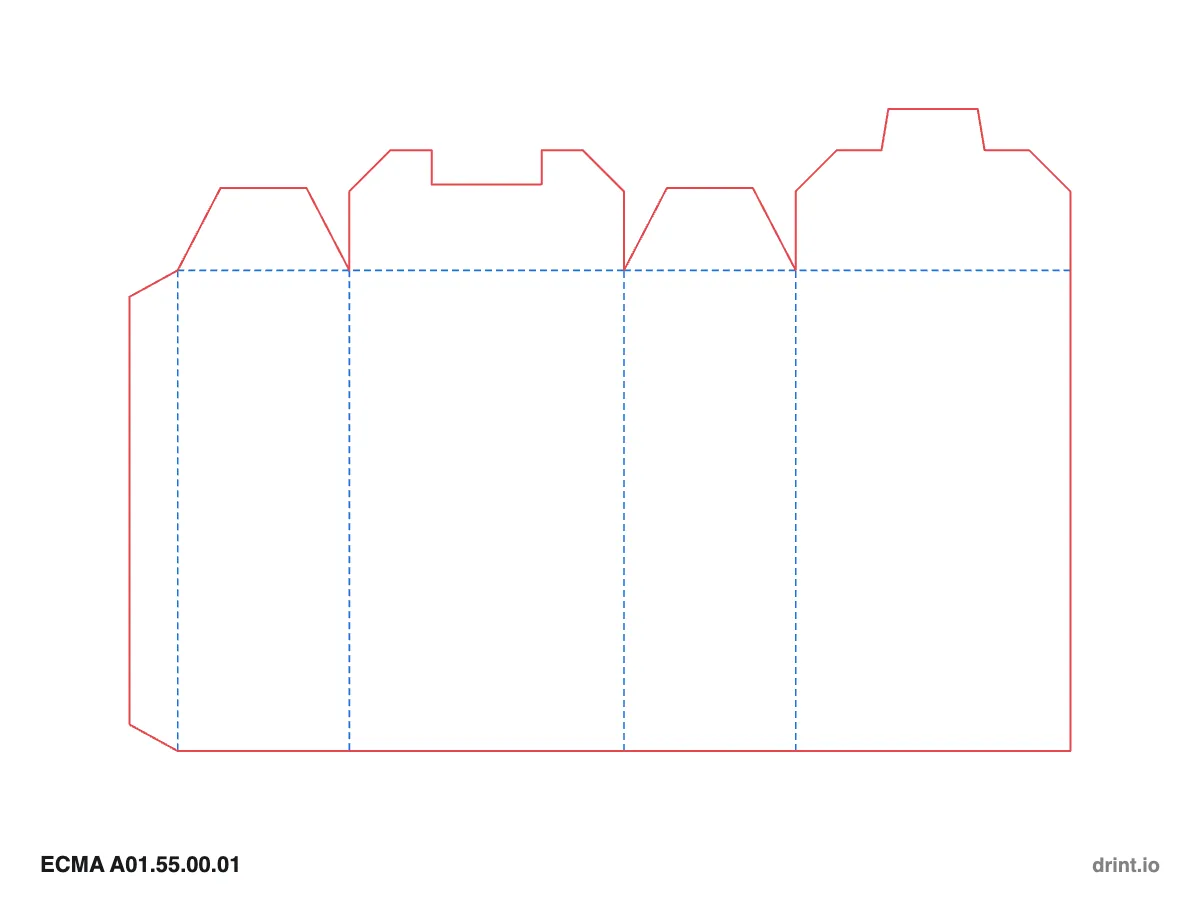
ECMA A01.55.00.01 is a folding carton (ECMA A-series) whose top is a 1-2-3 snap lock and whose bottom is open. An open bottom makes it a sleeve or tube: it slides over a tray or a product, or is closed by a separate insert. Drint draws a free ECMA A01.55.00.01 dieline at any size: type the length, width and height and design on it, or download it as PDF or SVG with Pro.
- Code
- ECMA A01.55.00.01
- Standard
- ECMA — folding carton
- Group
- ECMA A01 · Open bottom (sleeves, tubes)
- Drawn at
- 80 × 50 × 140 mm
- Flat sheet
- 274 × 187 mm
- Drawing
- Follows the code’s drawing
In Claude or ChatGPT, add the Drint connector (drint.io/mcp) and ask: “ECMA A01.55.00.01 dieline, 300 × 200 × 100 mm, PDF”.
How it folds
A01.55.00.01 closes the top with a double snap-lock (1-2-3) end hinged on the back panel (01), and leaves the bottom open. Used at the top, the four interlocking 1-2-3 flaps become a double snap-lock end: folded by hand in sequence, starting with the main flap on the back panel (01), they hold without glue and open by reversing the fold. The open bottom makes it a sleeve or hood: it drops over the product, slides over a tray or base, or is closed later by an insert.
What it is used for
As a double snap-lock top it closes by hand without glue and is firm enough for heavier goods, such as hardware, kitchen items or bottled products packed by hand. The main lock flap on the back panel (01) sets which side the hand-folding sequence starts from. With the bottom open it can cap a product or a base tray, or become a tube closed later by an insert.
Blank size by box size
The flat sheet a ECMA A01.55.00.01 needs at each box size, measured on Drint’s own dieline with the board’s thickness allowed for. Add your press’s trim and gripper margin. Each size opens the die in the studio.
| Box, L × W × H | Flat sheet | Sheet area |
|---|---|---|
| 40 × 25 × 70 mm | 144 × 94 mm | 0.01 m² |
| 55 × 35 × 100 mm | 194 × 134 mm | 0.03 m² |
| 80 × 50 × 140 mm | 274 × 187 mm | 0.05 m² |
| 105 × 65 × 180 mm | 354 × 241 mm | 0.09 m² |
| 130 × 80 × 225 mm | 434 × 297 mm | 0.13 m² |
| 160 × 100 × 280 mm | 534 × 362 mm | 0.19 m² |
Measured by Drint’s die engine
These numbers are measured on the ECMA A01.55.00.01 die at 80 × 50 × 140 mm, drawn by the same engine as the studio — not copied from a catalogue.
| Cutting rule | 1.03 m |
|---|---|
| Creasing rule | 0.82 m |
| Total rule per copy | 1.85 m |
| Blank area (board in the box) | 0.045 m² |
| Share of the bounding box used | 88.6% |
| Board per 1,000 blanks (bounding box) | 51 m² |
| Best press sheet | 65 × 86 cm: 9 up, 73.1% of the sheet used |
Parts of this die: Glue flap · Snap-lock bottom · Front panel · Side panel · Back panel
Board
Folding boxboard of 250–350 gsm is usual for an open-bottom carton, at the heavier end if it has to keep its shape over a tray or product. The interlocking flaps need clean creases and a board stiff enough to hold the lock; E-flute micro-flute suits heavier contents. The blank is the same size whichever wide panel carries the main lock flap; here it is the back panel (01).
Printing and die notes
The interlocked flaps form a visible pattern on the top, so keep it plain or design it to read as one pattern, and avoid text across the lock lines. With the bottom open, the inside of the walls shows when the carton is lifted off, so a white or printed inside looks finished. The last flap of the lock lands on the side away from the back panel (01), so check which face shows the neater side before placing the logo.
Common mistakes
- Expecting a machine to close the snap-lock top; it is folded by hand in sequence.
- Forgetting that the open bottom needs a tray, insert or base, so the product drops out when lifted.
- Soft creases, so the four flaps do not interlock evenly and the end bulges.
Questions
What is ECMA A01.55.00.01?
ECMA A01.55.00.01 is a folding carton (ECMA A-series) whose top is a 1-2-3 snap lock and whose bottom is open. An open bottom makes it a sleeve or tube: it slides over a tray or a product, or is closed by a separate insert.
Does the snap-lock top of A01.55.00.01 need glue?
No; the four flaps interlock when folded in sequence by hand and open again by reversing the sequence. It is slower than a tuck on a packing line, so it suits hand packing.
How does A01.55.00.01 differ from A01.55.00.03?
Only in which wide panel carries the main locking flap: here the back panel (01), in A01.55.00.03 the front panel (03). The lock itself is the same; choose by which way the fold sequence should run at the packing bench and which face should show the neater side of the interlock.
What size sheet does a 80 × 50 × 140 mm ECMA A01.55.00.01 need?
A ECMA A01.55.00.01 of 80 × 50 × 140 mm unfolds to a flat sheet of 274 × 187 mm (0.05 m²) on Drint’s dieline, before trim and gripper margins. The table on this page gives the sheet for other sizes; in the studio, type any length, width and height and the sheet is measured again.
How do I get a ECMA A01.55.00.01 dieline at my size?
Open it in Drint and type your length, width and height — inside, on the crease or outside. The die is redrawn at that size with the board’s thickness allowed for, and you design straight on it. In Claude or ChatGPT with the Drint connector, ask for “ECMA A01.55.00.01 dieline” and your size.
What board is ECMA A01.55.00.01 made from?
Folding boxboard of 250–350 gsm is usual for an open-bottom carton, at the heavier end if it has to keep its shape over a tray or product. The interlocking flaps need clean creases and a board stiff enough to hold the lock; E-flute micro-flute suits heavier contents. The blank is the same size whichever wide panel carries the main lock flap; here it is the back panel (01).
Is the ECMA A01.55.00.01 dieline free?
Designing on the die, the 3D fold and preflight are free in the browser. Downloading the dieline (SVG, PDF / AI, or DXF and CF2 for the die-maker) and the CMYK print PDF needs Pro.