Drint Knowledge › Packaging glossary › Salt and sodium declaration
Salt and sodium declaration
The amount of salt or sodium a food contains, shown in the nutrition table or as a separate warning.
- Also called
- sodium content, salt equivalent
- Kind
- Labels, barcodes & law
- Label laws that ask for it
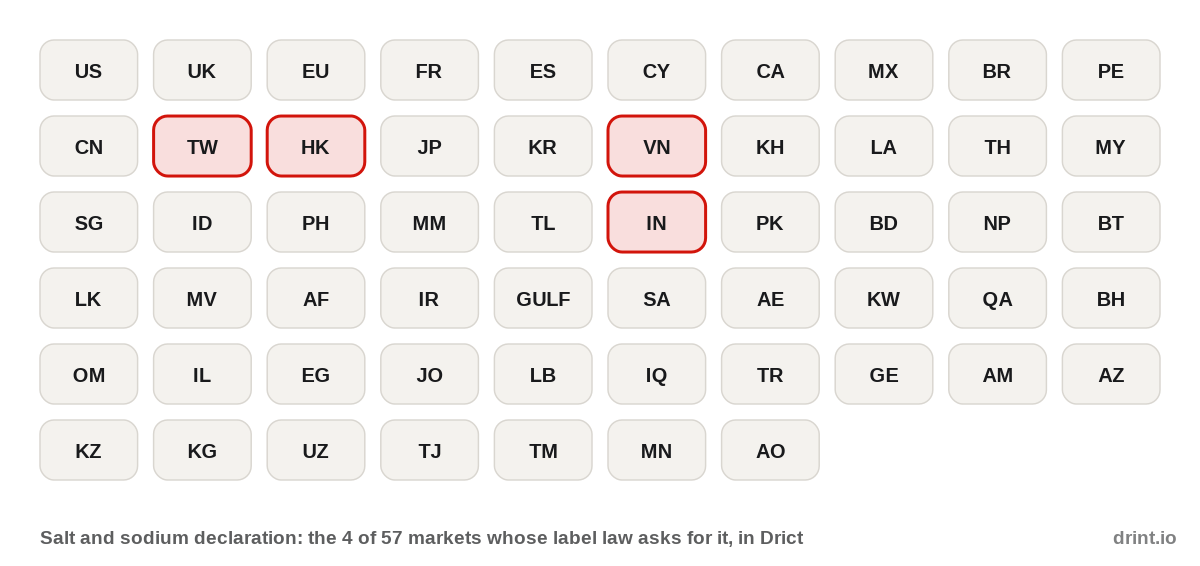
- 4 of the 57 markets Drint checks
- Mandatory in
- 4
- Example
- Nutrition label: energy, protein, fat, saturated fat, trans fat, carbohydrate, sugar, sodium (營養標示 — TFDA, from 2024-07-01)
- Measured
Some tables list sodium, others list salt, and a few list both. The two are related by a fixed conversion, so a pack can show either as long as the unit matches the rule for the market.
Check which of the two the market wants before setting the table, and label the column clearly. Where a high-salt warning applies, it is a separate element placed outside the table.
Where the law asks for it
Questions
What is a salt and sodium declaration?
The amount of salt or sodium a food contains, shown in the nutrition table or as a separate warning.
More terms
Cite this page: Drint (2026). “Salt and sodium declaration”. Drint Knowledge. https://drint.io/glossary/salt-and-sodium-declaration