Dielines › Dielines by standard code › ECMA F70.01.00.00
ECMA F70.01.00.00 — Pillow box with curved end flaps
ECMA F70.01.00.00 is a pillow-shaped carton with a glued side seam whose curved end flaps fold in over each other to close. Drint draws a free ECMA F70.01.00.00 dieline at any size: type the length, width and height and design on it, or download it as PDF or SVG with Pro.
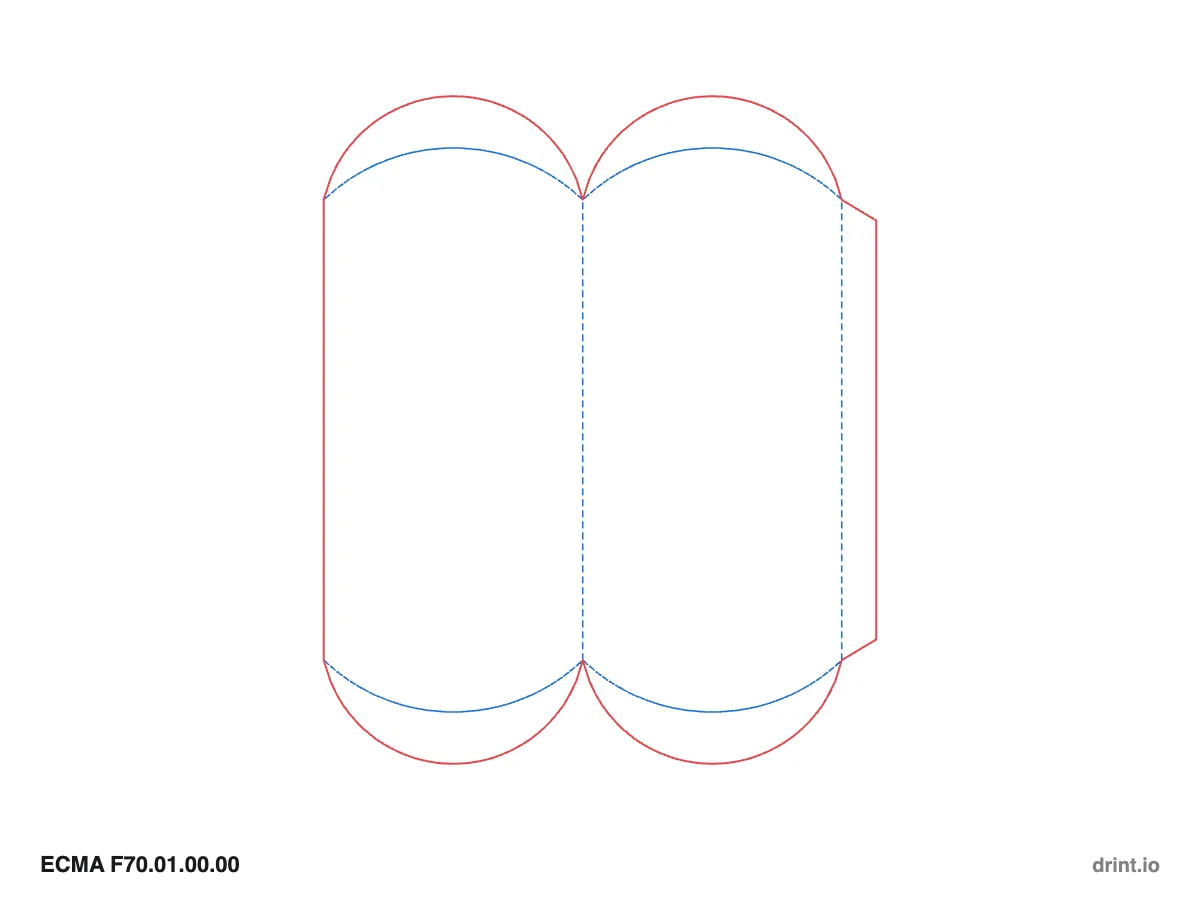
- Code
- ECMA F70.01.00.00
- Standard
- ECMA — folding carton
- Group
- ECMA F · Special styles (pillow, envelope, cup, inserts, dividers)
- Drawn at
- 160 × 90 × 30 mm
- Flat sheet
- 192 × 232 mm
- Also called
- Pillow box overlapping flaps
- Drawing
- Close to the code’s drawing, not exact
In Claude or ChatGPT, add the Drint connector (drint.io/mcp) and ask: “ECMA F70.01.00.00 dieline, 300 × 200 × 100 mm, PDF”.
Full guide to this structure: Pillow box →
How it folds
F70.01.00.00 is a flat tube glued along its length whose two ends close by pressing in curved flaps along curved creases, which makes the body bulge into a pillow. Drint's sample is 160 mm long along the side crease, 90 mm wide and 30 mm deep, 196 mm over the curved ends, with 18 mm deep curved creases and flaps and a 12 mm glue flap. Drint draws the style in its own geometry and the curvature is a reference, so check the box maker's drawing and cut a sample before production.
What it is used for
Gift and favour boxes, jewellery, accessories, hair ties, soap, chocolates, gift cards and small apparel items. It ships and stores flat, assembles in a second and looks finished without a lid.
Blank size by box size
The flat sheet a ECMA F70.01.00.00 needs at each box size, measured on Drint’s own dieline with the board’s thickness allowed for. Add your press’s trim and gripper margin. Each size opens the die in the studio.
| Box, L × W × H | Flat sheet | Sheet area |
|---|---|---|
| 80 × 45 × 15 mm | 102 × 152 mm | 0.02 m² |
| 110 × 65 × 20 mm | 142 × 182 mm | 0.03 m² |
| 160 × 90 × 30 mm | 192 × 232 mm | 0.04 m² |
| 210 × 115 × 40 mm | 242 × 282 mm | 0.07 m² |
| 255 × 145 × 50 mm | 302 × 327 mm | 0.10 m² |
| 320 × 180 × 60 mm | 372 × 392 mm | 0.15 m² |
Measured by Drint’s die engine
These numbers are measured on the ECMA F70.01.00.00 die at 160 × 90 × 30 mm, drawn by the same engine as the studio — not copied from a catalogue.
| Cutting rule | 0.83 m |
|---|---|
| Creasing rule | 0.72 m |
| Total rule per copy | 1.55 m |
| Blank area (board in the box) | 0.040 m² |
| Share of the bounding box used | 90.4% |
| Board per 1,000 blanks (bounding box) | 45 m² |
| Best press sheet | 72 × 102 cm: 14 up nested (grid: 12), 76.8% of the sheet used |
Parts of this die: Glue flap · Front panel · Back panel · Curved end flap
Board
Folding boxboard or SBS 300–350 gsm; curved creases need board that bends without cracking, and kraft or metallic boards are popular. Thick board makes the ends hard to press closed.
Printing and die notes
Both broad faces curve, so artwork should avoid fine straight lines near the ends where the curve is strongest. Solid colours across curved creases may crack; a matching board colour hides this.
Common mistakes
- Going straight to production without a sample, then finding the curve too tight for the board.
- Putting text into the curved flap area.
- Using board so thick the ends will not stay closed.
Questions
What is ECMA F70.01.00.00?
ECMA F70.01.00.00 is a pillow-shaped carton with a glued side seam whose curved end flaps fold in over each other to close.
Why does Drint suggest a test cut?
Curved creases behave differently with each board, so the curve depth may need adjusting.
How are pillow box sizes given?
Length along the side crease, width, and the bulge depth; the total over the curved ends is longer (196 mm in the sample).
What size sheet does a 160 × 90 × 30 mm ECMA F70.01.00.00 need?
A ECMA F70.01.00.00 of 160 × 90 × 30 mm unfolds to a flat sheet of 192 × 232 mm (0.04 m²) on Drint’s dieline, before trim and gripper margins. The table on this page gives the sheet for other sizes; in the studio, type any length, width and height and the sheet is measured again.
How do I get a ECMA F70.01.00.00 dieline at my size?
Open it in Drint and type your length, width and height — inside, on the crease or outside. The die is redrawn at that size with the board’s thickness allowed for, and you design straight on it. In Claude or ChatGPT with the Drint connector, ask for “ECMA F70.01.00.00 dieline” and your size.
What board is ECMA F70.01.00.00 made from?
Folding boxboard or SBS 300–350 gsm; curved creases need board that bends without cracking, and kraft or metallic boards are popular. Thick board makes the ends hard to press closed.
Is the ECMA F70.01.00.00 dieline free?
Designing on the die, the 3D fold and preflight are free in the browser. Downloading the dieline (SVG, PDF / AI, or DXF and CF2 for the die-maker) and the CMYK print PDF needs Pro.
Is Drint’s ECMA F70.01.00.00 exactly the FEFCO drawing?
Not exactly: Drint draws this code close to the FEFCO drawing. Check the die with your die-maker before production.