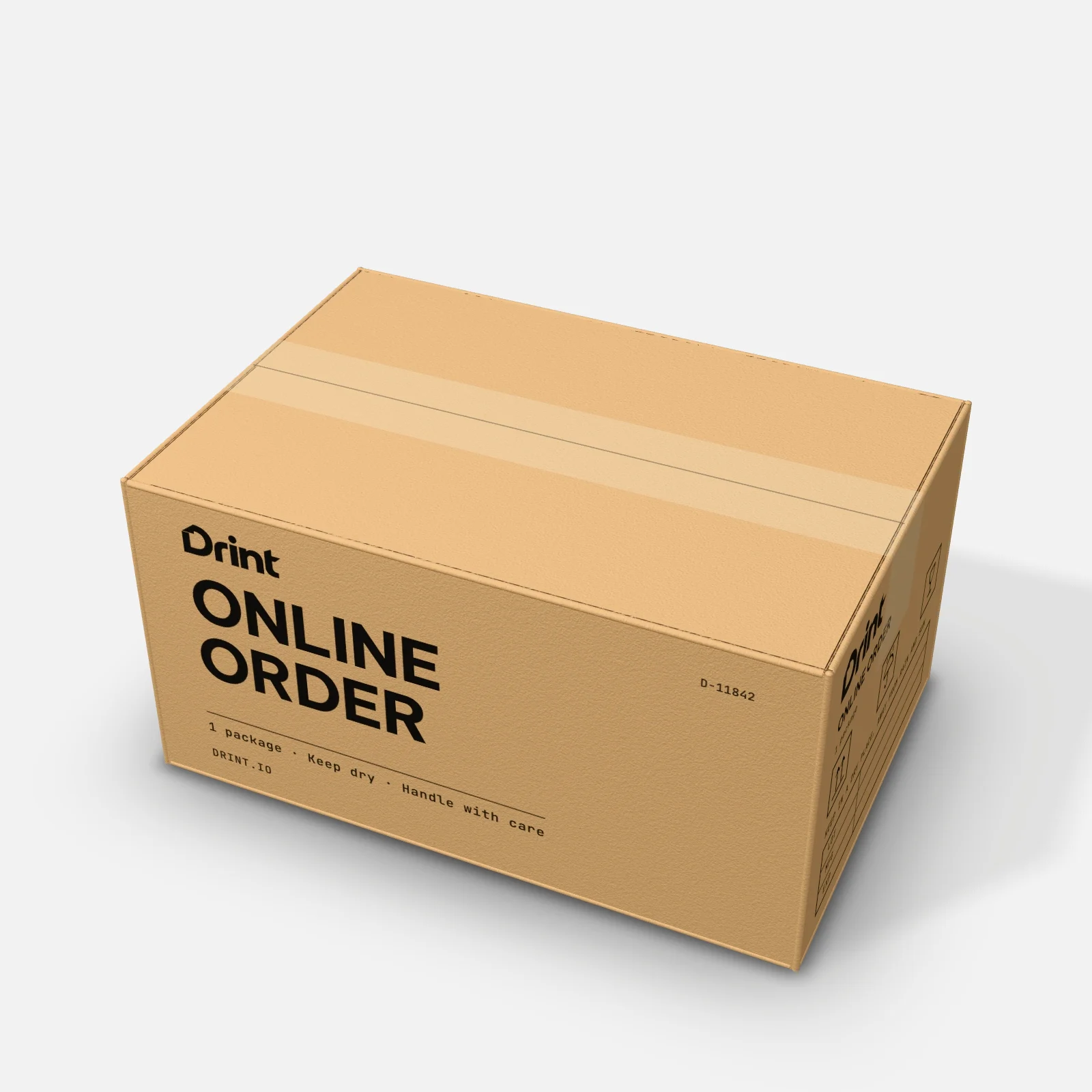
Shipping box
Nº D-11842
Online orders.
Made for: Fashion & retail.
Sample printed on brown-liner corrugated board, uncoated; style: shipping carton, flaps meet – FEFCO 0201.
Sample size mm.
About this mockup
The regular slotted carton (FEFCO 0201, RSC) is the world's most common corrugated box — four flaps meeting in the middle; 3, 5 or 7 ply by load. 1–2 colour flexo on kraft covers most distribution goods.
- Usually holds
- Online orders.
- Who uses it
- Online shops, fulfilment.
- Popular in
- Worldwide.
- Also searched as
- shipping carton set · 3 ply mailing carton · packing box · online shipping carton
How to use this mockup
- Start from the undefined mm sample or type your own size.
- Design straight on its real dieline.
- Turn it in 3D, export a picture or video, or stage a scene.
This mockup’s dieline: Shipping carton (FEFCO 0201)
Trade tips
- Handling marks (fragile, this way up) go in an upper corner, at least 20 mm high.
- For e-commerce mailers, printing inside the lid is a cheap way to make the unboxing feel special.
- On brown corrugated, colours print darker than on screen: proof on kraft first.
- Unlaminated paper keeps its natural feel but scuffs easily: fine for short-lived packs.
Questions
Is the shipping box mockup free?
Yes, commercial use included; Free adds a watermark grid at 1K, Pro exports 4K without it.
Can I use my own size for the shipping box?
Yes — from the undefined mm sample or your own size, with the dieline redrawn.
Can I get the shipping box dieline for printing?
Yes, with Pro: the die files (SVG, PDF / AI, DXF / CF2) and the CMYK print PDF; designing on the die is free.
What is the shipping box sample printed on?
The sample is brown-liner corrugated board with no lamination, on a dieline drawn at the size you type.
Construction
One sheet of corrugated board, slotted and scored, joined into a tube by a glued or stitched manufacturer's joint; four top and four bottom flaps, the long flaps meeting in the middle (FEFCO 0201, RSC), taped when packed. Size is always given as internal dimensions: length × width × height.
Choosing board and material
Single-wall board for light and medium goods; double-wall for heavy goods and tall stacks; triple-wall for very heavy loads. E flute is about 1.5 mm, B about 3 mm, C about 4 mm; brown kraft liners are cheap, white-top liners print better.
Finishing
Flexo in 1–3 colours printed straight onto the corrugated board — cheap, fast and fine for type and simple logos. For full-colour photography: print offset on paper and laminate it onto the board (litho-lam), at a higher cost.
Preparing the print file
The flat layout has four joined body panels, the joint and eight flaps. Flexo on corrugated spreads, so keep type at about 8 pt or more, strokes not thin, and avoid fine halftone images. Add handling symbols (this way up, fragile, keep dry, stacking limit) and a box for item code and quantity on a side.
Common mistakes
- Giving external instead of internal dimensions: the goods don't fit.
- Fine halftone images for direct flexo: they print muddy and the flute pattern shows.
- Single-wall for heavy stacked goods: the bottom cartons crush in storage.
Questions and answers
Single-wall or double-wall?
Single-wall for goods under about 10–15 kg stacked low; double-wall for heavier goods, drinks and tall pallet stacks. Ask the maker about compression strength for your warehouse stacking.
Flexo or litho-lam for cartons?
Flexo for shipping cartons with simple type and logos; litho-lam when the carton is a display or gift pack that needs beautiful imagery.
Why is the 0201 the most common carton?
A simple die, little waste, quick to fold, and every corrugated plant can make it in any size.
Sizes available
- 200 × 150 × 100 mm
- 300 × 200 × 150 mm