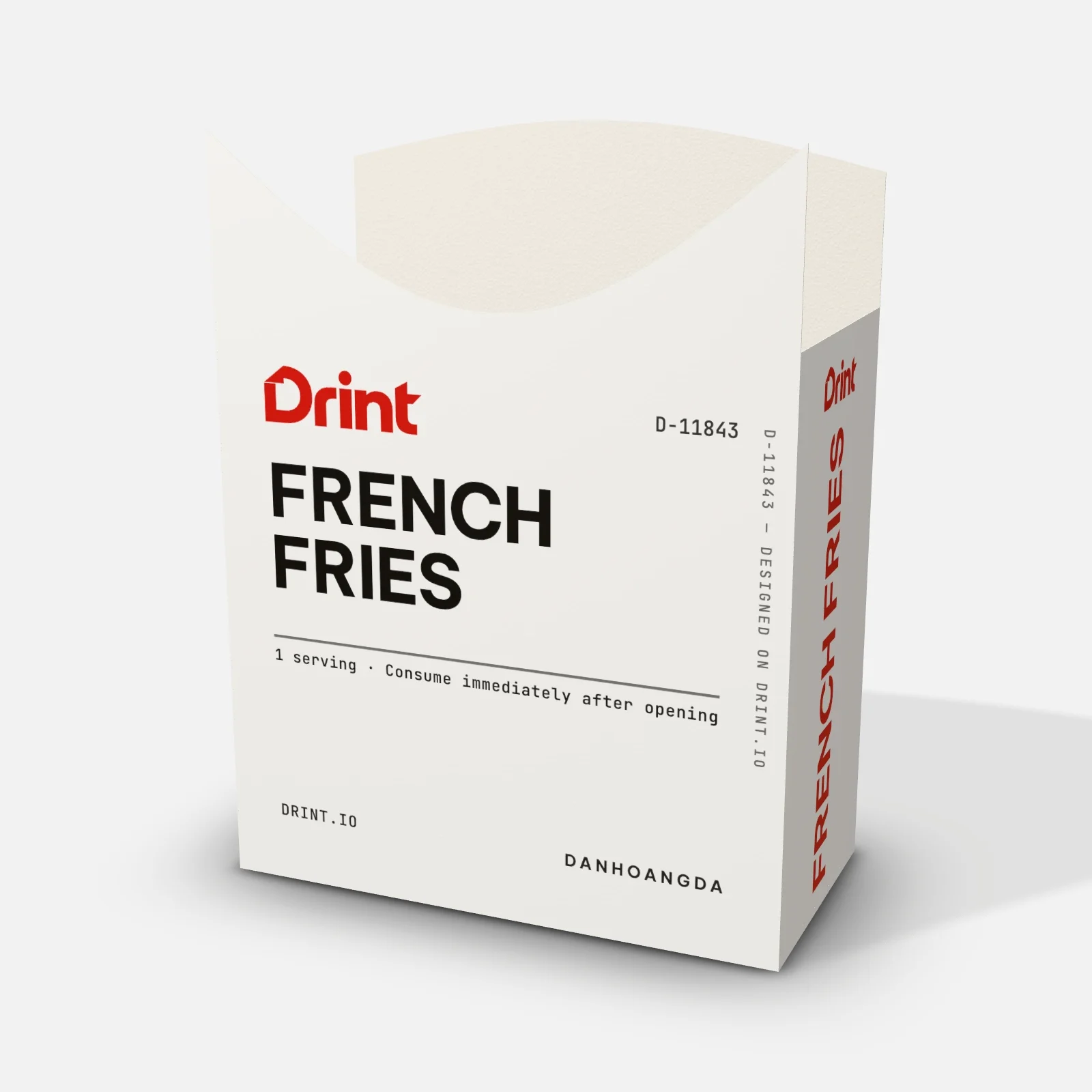
Fries box
Nº D-11843
Size S.
Made for: Food & specialties.
Sample printed on ivory (C1S board) 300 gsm, matte lamination; style: fries / popcorn box.
Sample size mm.
About this mockup
Fry scoops and popcorn boxes are grease-resistant fast-food cartons: a flared mouth, no lid, held in one hand. The design must read from afar because it travels in customers' hands.
- Usually holds
- Medium fries and nuggets.
- Who uses it
- Fried-chicken and burger shops, food trucks.
- Popular in
- Worldwide; Vietnam, Thailand, the Philippines.
- Also searched as
- fries box · french fry scoop · fries carton · nugget box mockup
How to use this mockup
- Start from the undefined mm sample or type your own size.
- Design straight on its real dieline.
- Turn it in 3D, export a picture or video, or stage a scene.
Trade tips
- Check the text direction on the side panels when folded: it is easy to end up upside down on a flat die.
- Run the artwork 3 mm past the cut line and keep text 3 mm inside it.
- Ivory board prints best on its coated face; keep the uncoated inside to one colour.
- Matte lamination feels premium and softens colours by about a shade: add contrast in the design.
Questions
Is the fries box mockup free?
Yes, commercial use included; Free adds a watermark grid at 1K, Pro exports 4K without it.
Can I use my own size for the fries box?
Yes — from the undefined mm sample or your own size, with the dieline redrawn.
Can I get the fries box dieline for printing?
Yes, with Pro: the die files (SVG, PDF / AI, DXF / CF2) and the CMYK print PDF; designing on the die is free.
What is the fries box sample printed on?
The sample is ivory (C1S board) 300 gsm with matte lamination, on a dieline drawn at the size you type.
Construction
One die-cut sheet: the front is lower, often with a curved scoop, and the back is tall; the base is locked or glued and the top is open. A popcorn box tapers from mouth to base and may have folds to stand steady. It ships flat and is set up for use.
Choosing board and material
Food board of 250–350 gsm with grease resistance: PE-coated inside, or plastic-free grease-resistant board. Outside inks should be food-packaging (low-migration) inks. Don't use ordinary recycled board where hot fried food touches it.
Finishing
Usually 1–4 colours with no lamination, keeping it cheap and recyclable; a water-based varnish outside helps against scuffs. Bold, big blocks of colour that read from afar.
Preparing the print file
The tall back is the main face, for the big logo; the low curved front should keep type away from the curve. The inside can carry one colour (a message, a QR) unless the grease barrier can't be printed. Ask the maker which faces print before designing.
Common mistakes
- Board without grease resistance: oil soaks through and blots the print within minutes.
- The logo on the low front: once full, the fries hide it.
- Lots of small type: it's held in one hand and glanced at — nobody reads small text.
Questions and answers
Does a fries box keep fries crisp?
The open top lets steam escape, so fries stay crisp longer than in a closed box; for delivery, there are vented versions or open fold-over lids.
Can popcorn boxes hold other food?
Yes for dry snacks, chicken or fish balls, potato wedges; wet or sauced dishes need a cup or lidded box.
Is a fries box recyclable?
Plastic-free grease-resistant board recycles more easily than PE-coated board; heavily oiled boxes usually don't go into paper recycling.
Sizes available
- 75 × 40 × 80 mm
- 90 × 45 × 90 mm
- 110 × 55 × 110 mm